
 There is absolutely nothing wrong with rolling a chocolate truffle in cocoa powder. It's classic for a reason.
But once you have made a few thousand truffles, you begin to realise that cocoa powder is only the beginning.
One of the simplest ways to change the appearance, flavour and personality of a truffle is to change the coating.
And increasingly, I have been experimenting with something rather humble:
vegetables. I'm not trying to sneak someone's five-a-day into a box of chocolates.
Vegetable powders can be colourful, full of flavour and importantly remarkably economical.
Fruit Powder Is great but. It can be expensive.
Freeze-dried raspberry, strawberry, blackcurrant, mango and passion fruit powders are fantastic ingredients.
They give concentrated flavour, acidity and often terrific colour, without introducing the amount of water contained in fresh fruit.
The problem is price.
Fruit powders, particularly freeze-dried berry powders, can become expensive surprisingly quickly when you move from making twelve truffles at home to producing hundreds commercially.
Vegetable powders are a different proposition.
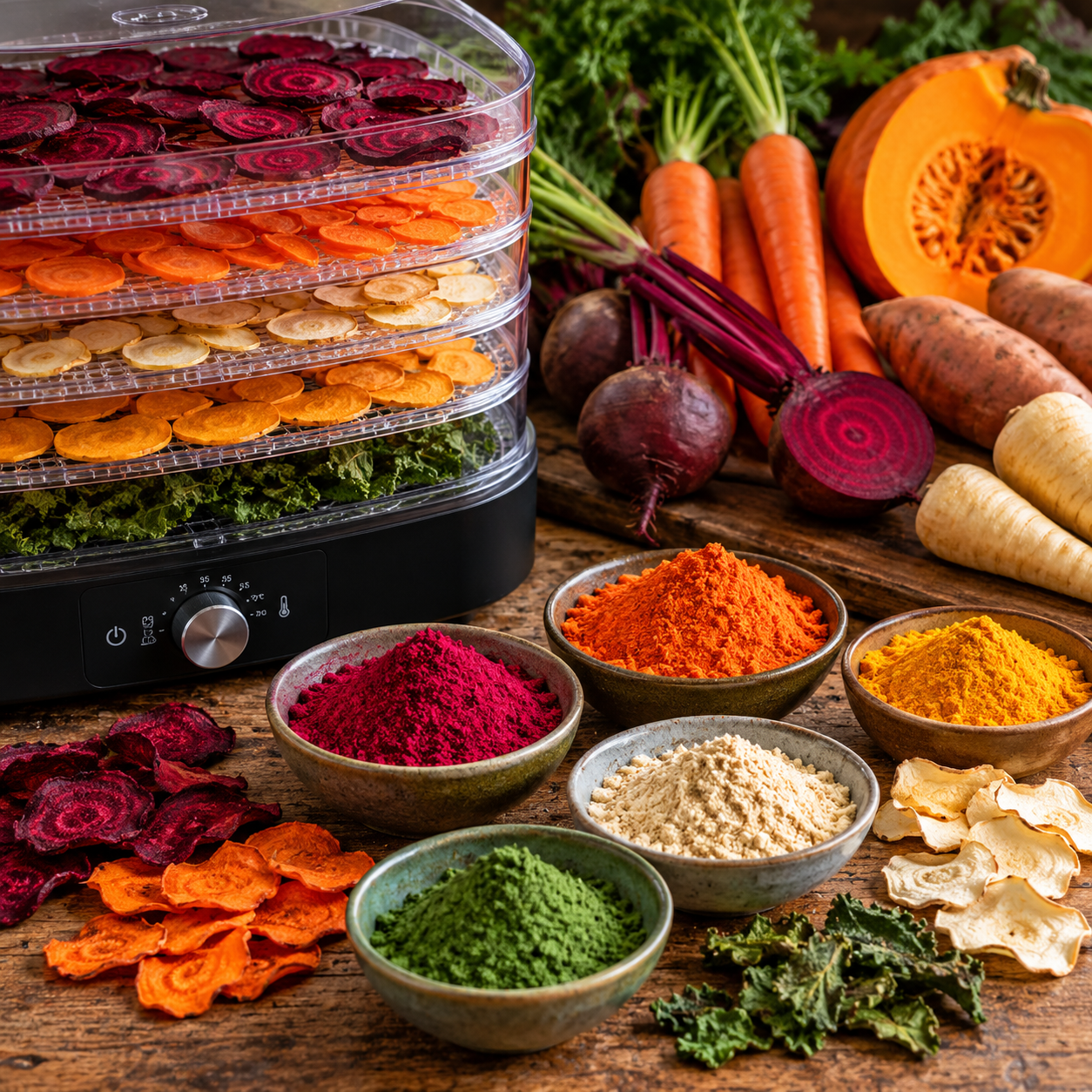
Carrot. Beetroot. Sweet potato. Pumpkin. Parsnip. Even spinach.
All are relatively humble ingredients, and several can either be bought economically as powders or produced from inexpensive fresh vegetables.
That means we can start treating the coating of a truffle almost like a chef treats seasoning.
Rather than What can I roll this in? It should be What flavour does this chocolate need?
The Price Difference Can Be Dramatic
At the time of writing,
Buy Whole Foods Online lists 500g of beetroot powder at £10.09, equivalent to £2.02 per 100g.
The same retailer lists 200g of freeze-dried whole raspberries at £24.47. They specifically note that these can be crushed or blended into raspberry powder.
That works out at approximately:
£24.47 ÷ 2 = £12.24 per 100g.
So, on that comparison: raspberry is 6.1 times the price of the beetroot.
Scale that up to a theoretical kilogram of coating and the difference becomes even clearer:
Beetroot powder: about £20.20 per kg
Freeze-dried raspberry: about £122.40 per kg
A difference of approximately £102.20 per kilogram.
These are retail prices rather than wholesale quotations, and prices will change, but they demonstrate why vegetable powders can be commercially interesting.
Strawberry powder shows the same pattern.
A current 500g pack of freeze-dried strawberry powder is listed at £34.62, or £6.92 per 100g.
By comparison, the retailer's natural food colouring range currently starts carrot powder at £2.70 and beetroot powder at £3.30, while freeze-dried strawberry powder starts at £8.42 and raspberry powder at £15.48.
Those starting prices are for differing pack sizes, so they should not be compared directly by weight, but they reinforce the broader point: freeze-dried fruit powders sit at a considerably more premium price point.
For anyone making chocolates commercially, those numbers deserve attention.
Beetroot and Dark Chocolate
Beetroot is probably the vegetable I would recommend trying first.
It produces a striking red-purple powder and has an earthy sweetness that works particularly well with dark chocolate.
Think about pairing it with:
Orange
Ginger
Raspberry
Blackcurrant
Balsamic
Cocoa nibs
A simple coating blend might be:
30g beetroot powder
10g cocoa powder
5g icing sugar, optional
The cocoa pulls the coating back towards chocolate while still allowing the beetroot colour and flavour to come through.
And this is where blending becomes useful.
You don't necessarily have to use any powder neat.
Carrot Might Be Even More Interesting
Carrot powder gives you a beautiful warm orange colour and immediately opens up a whole family of flavours.
Think carrot cake:
Cinnamon
Ginger
Orange
Cardamom
Walnut
Hazelnut
Vanilla
Try:
25g carrot powder
10g icing sugar
2g cinnamon
A pinch of ground ginger
Roll a milk chocolate and orange truffle in that and suddenly an extremely inexpensive vegetable has become part of a genuinely interesting chocolate.
That is what I like about this idea.
Cheap ingredients do not have to produce cheap-tasting food.
Sweet Potato
Sweet potato is another obvious candidate.
It has natural sweetness and pairs beautifully with:
Cinnamon
Ginger
Maple
Pecan
Caramel
Vanilla
Milk chocolate
A caramel ganache coated in sweet potato powder, cinnamon and a little cocoa would make a very good autumn truffle.
Pumpkin
Pumpkin on its own can be quite restrained.
Add spice and it comes alive.
Think:
Pumpkin + cinnamon + ginger + nutmeg + white chocolate.
Or go further and add finely crushed toasted pumpkin seeds for texture.
Now the coating is giving you colour, flavour and crunch.
Parsnip
Don't overlook parsnip.
It has sweetness and a gentle nutty character that could work particularly well with:
Honey
Hazelnut
Apple
Nutmeg
Cinnamon
White chocolate
It is not a loud flavour.
But not every chocolate needs to shout.
Tomato Gets Interesting
Tomato takes us in a completely different direction.
Dried tomato powder gives sweetness, acidity and savoury depth.
I would pair it with:
Dark chocolate + chilli + smoked paprika + sea salt.
That is probably not the truffle you put in the children's selection box.
But as part of a tasting menu, drinks pairing or adventurous chocolate collection?
Absolutely.
Green Powders
Spinach powder can give you an intense natural green, although you need to be much more careful with the flavour.
Rather than using it by itself, I would consider blending small quantities with flavours such as:
Mint
Pistachio
Lemon
Matcha
White chocolate
The important lesson here is:
Never choose the powder simply because the colour looks good.
It still has to taste right.
Use Expensive Fruit Powders as Seasoning
This is where fruit powders come back into the picture.
Instead of covering a truffle entirely in expensive raspberry powder, use a small amount as part of a blend.
For example:
10g raspberry powder
20g cocoa powder
10g icing sugar
You still get raspberry colour, aroma and acidity, but the expensive ingredient is doing the job of seasoning rather than providing the entire coating.
You can take the idea further with beetroot.
Imagine:
Beetroot + raspberry + dark chocolate.
Let the economical beetroot provide the bulk and much of the colour, then use enough raspberry to lift the flavour.
That makes much more sense commercially.
My basic rule would be:
Use the economical ingredient for body, colour and volume; use the expensive ingredient for impact.
Build Your Own Coating Blends
Once you start thinking this way, a fruit or vegetable powder becomes one part of a seasoning blend rather than simply a coating in its own right.
Try combining powders with:
Cocoa powder
Icing sugar
Ground spices
Toasted milk powder
Coconut
Coffee
Tea
Malt powder
Finely ground nuts
Biscuit crumb
That gives you much greater control over flavour, texture and cost.
A little raspberry powder goes much further when combined with cocoa.
Carrot becomes much more interesting with ginger and cinnamon.
Beetroot becomes more chocolate-friendly when balanced with cocoa.
Essentially, we are seasoning the outside of the chocolate.
Making Your Own Vegetable Powders
A dehydrator is probably the easiest piece of equipment to use, although some vegetables can also be dried successfully in a low oven.
Preparation and drying requirements vary depending on the vegetable, so I would follow appropriate drying guidance for the particular ingredient rather than use one temperature for everything.
The broad process is straightforward:
Wash and prepare the vegetable.
Slice it evenly and thinly.
Blanch first where appropriate.
Dehydrate until thoroughly dry.
Allow it to cool completely.
Grind it finely.
Pass it through a sieve.
Store it in an airtight, moisture-proof container.
For truffle coatings, I want the finished vegetable very dry.
If it is still flexible or carrying residual moisture, it is not ready to become powder.
The finer you grind and sieve it, the more refined the coating will feel in the mouth.
A Few Combinations I Would Try
Dark Chocolate + Beetroot + Orange
Earthy, bitter and aromatic.
Milk Chocolate + Carrot + Ginger + Cinnamon
Almost carrot cake in chocolate form.
Milk Chocolate + Sweet Potato + Caramel
Soft, comforting and economical.
White Chocolate + Pumpkin + Nutmeg
Ideal for an autumn collection.
Dark Chocolate + Beetroot + Raspberry
An excellent way of stretching an expensive fruit powder.
White Chocolate + Parsnip + Honey
Subtle and slightly unexpected.
Dark Chocolate + Tomato + Chilli + Sea Salt
For the adventurous end of the chocolate box.
White Chocolate + Carrot + Orange + Cardamom
Bright, aromatic and visually striking.
Dark Chocolate + Beetroot + Blackcurrant
Deep, fruity and slightly earthy.
Think Like a Chef, Not a Catalogue
There is a temptation in chocolate making to assume innovation means buying another expensive ingredient.
Rare fruit.
Luxury nuts.
Premium alcohol.
Speciality flavourings.
There is nothing wrong with any of them.
But chefs have always created interesting food by doing something clever with inexpensive ingredients.
The humble carrot is a perfect example.
Roast it.
Ferment it.
Smoke it.
Dehydrate it.
Powder it.
Suddenly it becomes several different ingredients.
That thinking belongs in the chocolate kitchen too.
Cheap Does Not Mean Inferior
This is probably the most important point.
An ingredient does not have to be expensive to be interesting.
A carrot costs very little.
A beetroot costs very little.
A sweet potato is hardly a luxury ingredient.
Yet once dehydrated, powdered, seasoned and paired properly with chocolate, each can become something distinctive.
That is good kitchen thinking.
It can reduce ingredient costs.
It can create unusual flavour combinations.
It can give us interesting natural colours.
It can turn potential surplus into something useful.
And it encourages us to look at ingredients differently.
The chocolate truffle is a blank canvas.
Cocoa powder is only one colour.
Your vegetable rack may contain the next one.
One small editorial point: I’d keep the actual supplier name and figures in the post because the £2.02 versus £12.24 per 100g comparison is powerful, but add “prices checked September 2026” underneath the table so the article doesn’t imply those retail prices are permanent.