
Some journeys teach you through distance.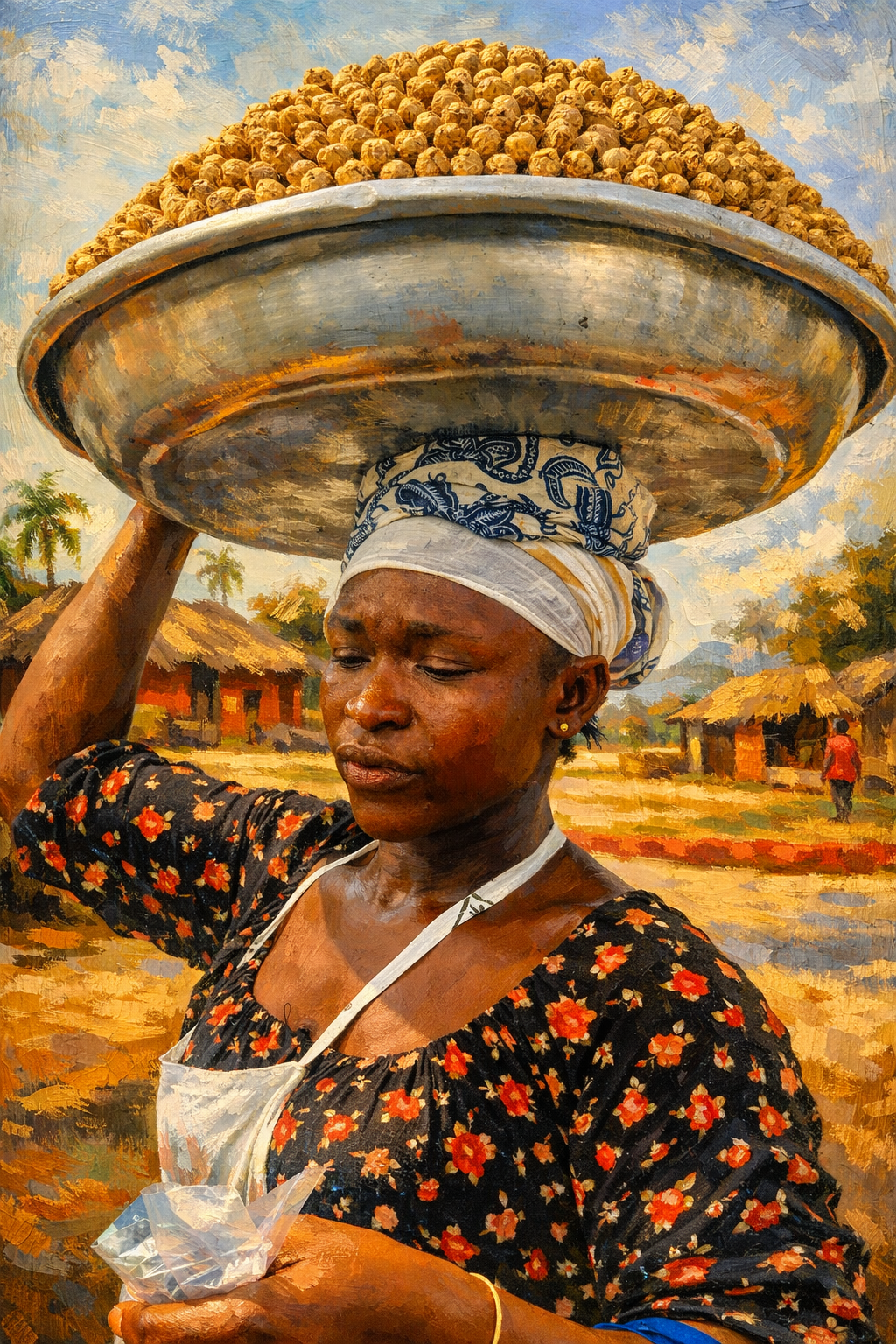
Others teach you by watching who carries what and how.
In Ghana, the head pan tells you almost everything you need to know.
You see it everywhere once you start noticing it.
Along the coast, where salt hangs in the air.
In the markets of Accra, dense with voices and movement.
On red-earth roads winding through cocoa country, where the heat settles early and stays all day.
Aluminium, most often.
Sometimes enamel, worn thin and softened by years of use.
Occasionally steel practical, durable, unassuming.
Balanced on the head as if it belongs there.
For many Ghanaian women, the head pan is not simply a tool.
It is a companion through life.
I have seen it carry water and firewood, cassava and fish, peppers, plantain, charcoal, cooked food, raw ingredients, and cocoa pods still warm from the field.
It carries trade. It carries movement. It carries the economy quietly and it carries it with dignity.
I think of Makola Market in the morning, before the day fully claims the city.
The air is thick with scent: ginger, onions, smoked fish, red palm oil, diesel. Traders call out prices in overlapping rhythms that rise and fall like song. Hands move quickly. Money changes shape and direction. Everything is in motion.
Head pans catch the sunlight as women pass through narrow lanes, balanced and unhurried.
The skill is learned young a folded cloth placed on the head, a basin lifted, posture adjusted, balance found.
What follows is muscle memory refined into something almost choreographed.
One hand steadies the load.
The other counts change, gestures, negotiates.
Their backs are straight. Their gaze is forward.
In a world that so often leans toward imbalance, they have mastered equilibrium.
On the roadside, between tro-tros and taxis, another rhythm unfolds.
A young woman moves through traffic with calm precision. On her head is a silver pan stacked high with boiled eggs brown and white arranged into a perfect pyramid.
Each step is measured, each egg holds its place as the pan sways gently with her stride.
A truck window lowers, a quick exchange, a smile, before she moves on.
There is beauty in that balance not performative, not decorative. Just work, done well.
Further along the road, tiger nuts (atadwe) fill another pan, edge to edge. Sweet, earthy, sustaining. A Ghanaian favourite sold roasted, raw, or blended into a milky drink that cools the heat and steadies the body.
The woman who carries them walks with a smile that seems to soften the sun itself, the load is heavy, her expression is not.
That contrast appears again and again in Ghana.
Hard work, lightness of spirit, grace under weight.
By the coast, the carrying looks different, but the meaning remains the same.
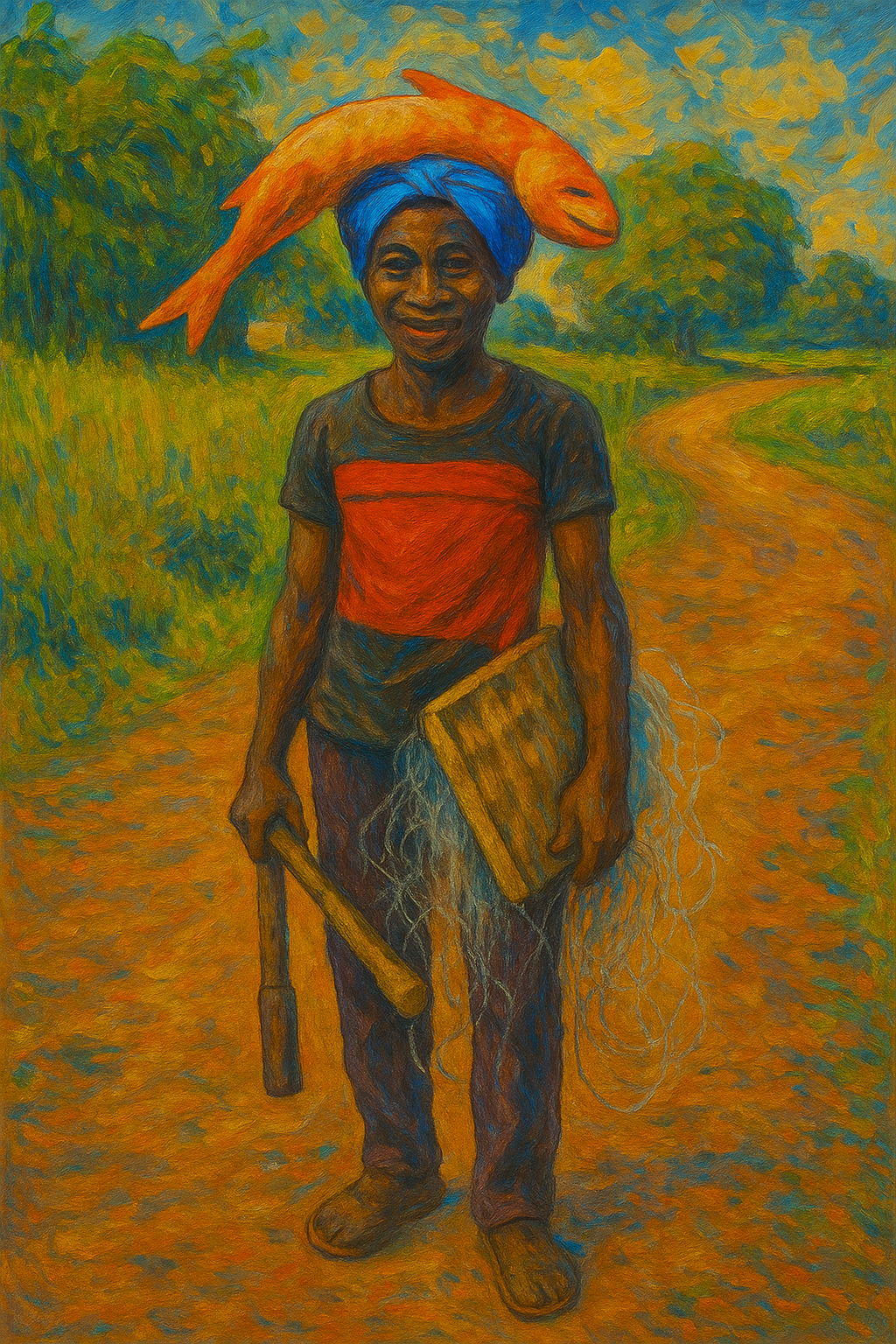
A man shoulders a bulging sack as boats edge toward shore. Charcoal. Cassava. Fishing gear. Whatever has come in must be carried out.
Here, carrying is not about gender.
It is about survival.
About keeping things moving.
Every back carries a story.
Every shoulder holds legacy.
This is Ghana at work.
In the hills, I watch a woman walking the roadside with a head pan stacked not with food, but with the tools of tradition: carved wooden mortars for pounding fufu, they rise like small towers above her head, balanced with astonishing precision. In one hand, smaller aluminium pans catch the light.
The mortars are handmade by her family. She sells them to passing drivers, to travellers heading inland, to households that still cook as their parents and grandparents did.
She carries craftsmanship from workshop to home, ensuring tradition continues to earn its keep.
In many communities, head pans form part of a bride’s dowry, they represent preparedness the ability to carry water, food, responsibility, to carry well is to be capable, balanced, resourceful.
It is praise as much as skill.
So when you see a Ghanaian woman walking tall with a pan on her head, she is doing more than transporting goods.
She is carrying family.
She is carrying culture.
She is carrying resilience learned and passed on, generation by generation.
Working closely with cocoa farmers and women’s cooperatives, I see the same grace and grit in the women who carry cocoa pods from field to fermentation. The pods are heavy, the distances are long, the work is relentless.
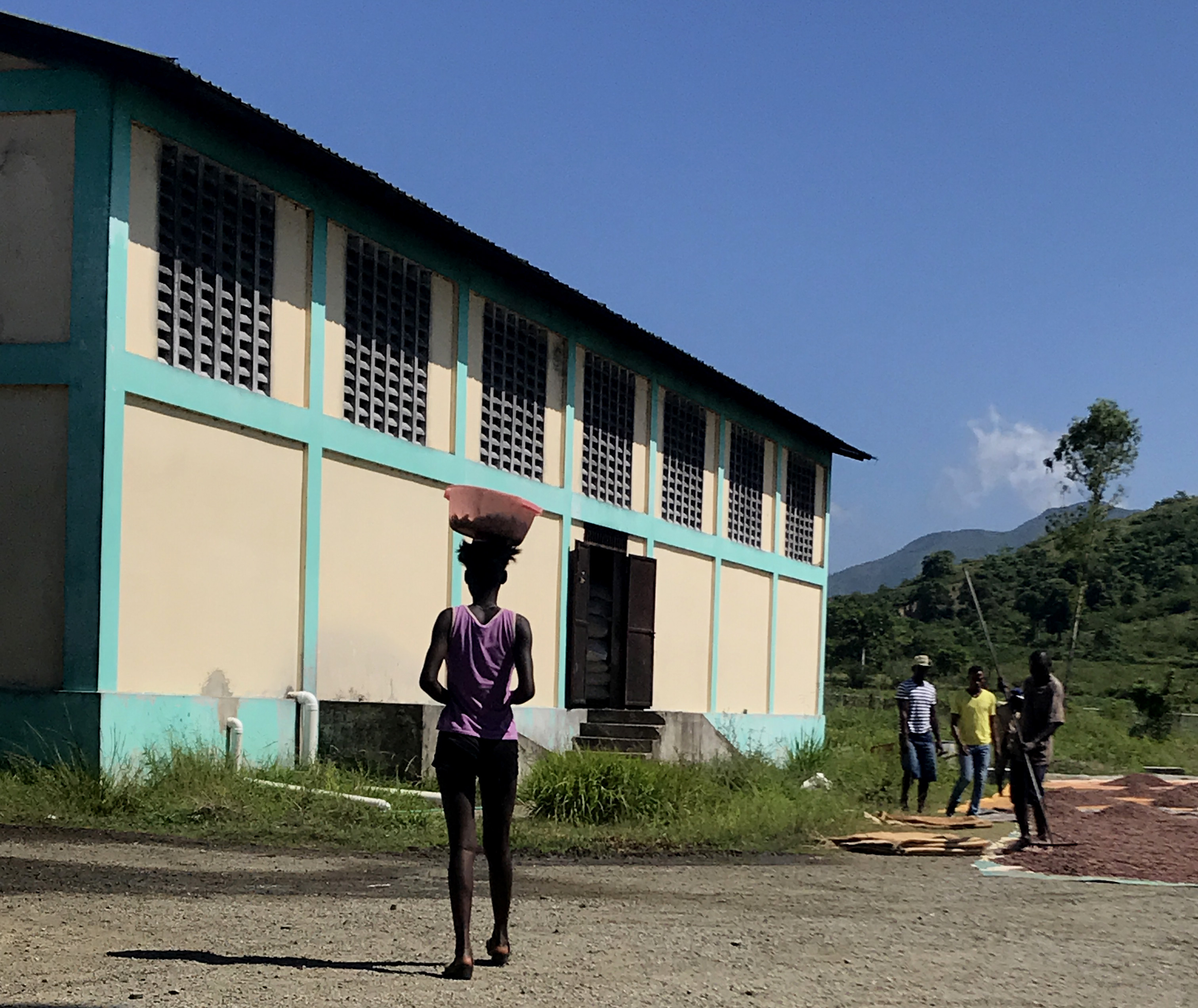 They carry the harvest and with it, the promise of something better.
Fairer trade.
Pride in origin.
Ghana’s story told in its own voice.
When I speak about women carrying the nation, these are the women I see.
Walking mile after mile with the fruit of the land balanced above them.
Steady.
Strong.
Unshaken.
A Note of Respect
To everyone who carries the market, the household, the cocoa sack, or the head pan this piece is for you.
You carry Ghana, and the world should learn how to see it.
 From Head Pan to Whole Pod
Watching how Ghana carries itself taught me something I didn’t fully understand when I first arrived.
Nothing is wasted here unless it is allowed to be.
The head pan does not discriminate between what is valuable and what is ordinary. Water, firewood, cassava peelings, cocoa pods, charcoal, tools everything that matters is lifted, balanced, and moved with care. Use determines worth. Necessity creates respect.
That way of carrying became the seed of my Whole Pod Philosophy™.
In cocoa, we have been taught to value only what travels well: the bean, the export, the finished bar. But standing at the roadside, in the markets, and at the edge of fermentation boxes, I saw something different a culture that understands survival depends on using what you have fully, not selectively.
The pulp has a purpose.
The husk has a future.
The shell still carries flavour, fuel, and meaning.
Nothing in the cacao fruit arrives without intention.
Whole Pod Philosophy™ did not begin in a workshop or on a whiteboard. It began by watching balance in motion weight carried with grace, value recognised through use, and dignity maintained even under load.
If we learn to carry cocoa the way Ghana carries daily life thoughtfully, completely, without waste then the future of chocolate may yet learn to walk more steadily.