
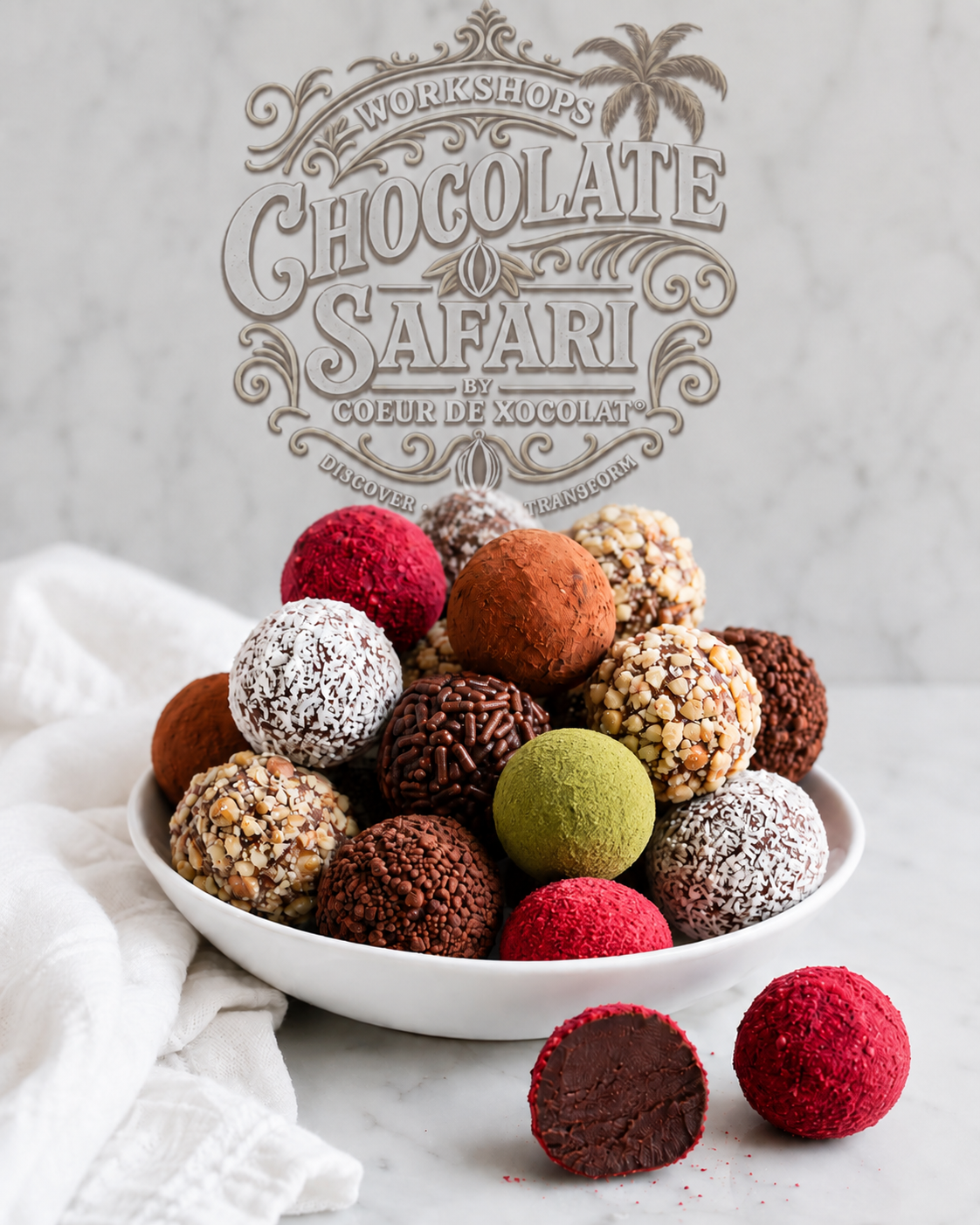
 Running a successful chocolate truffle workshop does not require shelves of expensive specialist ingredients.
Supermarket spices, coffee, biscuits, fruit powders and simple coatings can transform dark chocolate ganache—provided you control the quantities, allergens and packaging costs.
There is a particular kind of panic that arrives before a corporate chocolate workshop.
You got the chocolate.
You have the cream.
You have enough bowls to equip a small field hospital.
And then somebody asks the perfectly reasonable question:
“What can we flavour them with?”
This is usually the point where people start imagining expensive specialist ingredients, tiny bottles of obscure essential oils and powders imported from somewhere that requires three customs forms and a second mortgage.
It doesn't need to be like that.
Some of the best things you can put into a dark chocolate ganache are already sitting in the supermarket.
And some of the best things you can roll the finished truffle in are probably in your kitchen cupboard.
That is where the fun starts.
Start with the Ganache
Dark chocolate is a generous thing.
It will tolerate spice, bitterness, fruit, smoke, salt and the occasional bad idea.
That makes it perfect for workshops.
Give people a bowl of plain dark ganache and a collection of flavourings and suddenly they stop being delegates at a corporate event and become slightly competitive chocolatiers.
They sniff things, mix things.
They make combinations nobody asked for.
Sometimes they are brilliant.
Sometimes they taste like Christmas potpourri.
That is part of the fun.
The easiest flavourings are powders because they are cheap, clean and simple to portion.
Instant espresso powder is almost impossible to get wrong.
A little stirred into dark ganache deepens the chocolate and gives you that wonderful roasted bitterness that makes people assume you have done something far more sophisticated than opening a jar of coffee.
Cinnamon works.
Ginger works.
Cardamom works beautifully, but use it with restraint unless you want the entire room to taste like a spice market.
Chilli is obvious, but still worth having.
Dark chocolate and chilli became a cliché because the combination actually works.
Then there is mixed spice.
Five-spice.
Black pepper.
Matcha.
Smoked paprika.
All inexpensive.
All capable of changing a ganache completely.
And then there is freeze-dried fruit.
Raspberry in particular is excellent.
Crush it to a powder, stir a little into dark ganache and suddenly the chocolate wakes up.
The sharp acidity cuts through the richness and gives you something that tastes far more expensive than it is.
That is a useful lesson in itself.
Good flavour isn't always about expensive ingredients.
It is often about contrast.
The First Rule: Use Less Than You Think
People are enthusiastic.
This is dangerous.
Someone will always take a teaspoon of chilli and attack 100 grams of ganache with it. Don't let them.
The rule is simple:
Pinch. Mix. Taste. Repeat.
You can always add more.
Removing cardamom from ganache is much more difficult.
Dry powders also change texture.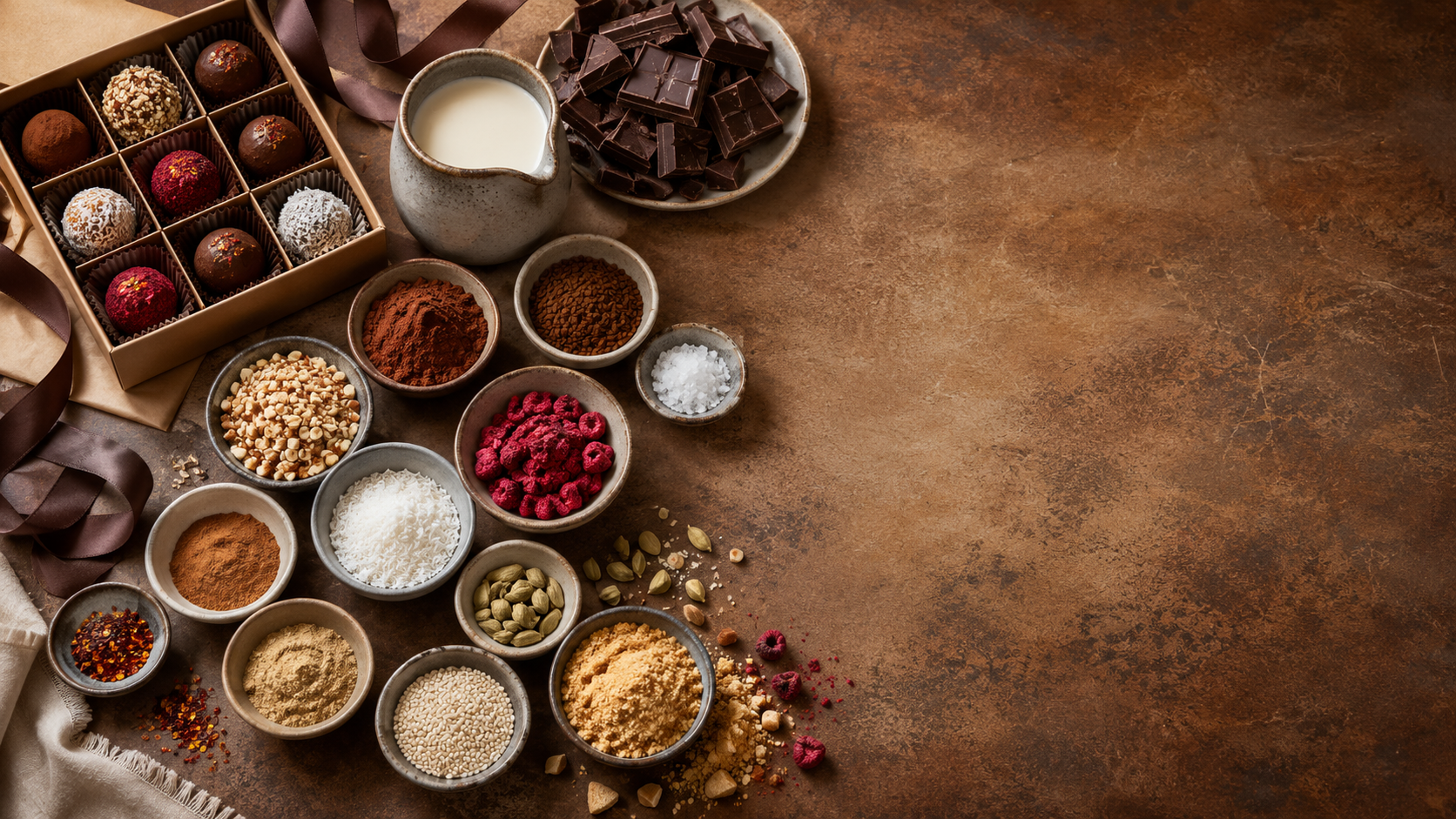
Cocoa, fruit powders and matcha absorb moisture, so too much will stiffen the mixture.
Again, this is not necessarily a disaster.
But it is useful to know why your silky ganache has suddenly developed the structural properties of putty.
Then Comes the Outside
This is where workshops should get visually interesting.
A traditional naked truffle is fine.
But a rolled truffle looks finished.
And once you give people several bowls of coatings, they start making choices.
Cocoa powder is the obvious one.
Still one of the best.
Bitter, dusty, classic.
Then you move outward.
Desiccated coconut.
Toasted coconut.
Crushed digestive biscuits.
Ginger biscuits.
Biscoff.
Finely chopped roasted nuts.
Sesame seeds.
Freeze-dried raspberry.
Crushed pretzels.
Honeycomb.
Chocolate sprinkles.
Grated chocolate.
Cornflakes.
Crisped rice
None of this is especially glamorous.
That is why it works.
You are showing people that flavour isn't dependent on a specialist catalogue.
It's built on understanding what each ingredient does.
A ginger biscuit brings spice, crunch and sweetness.
A pretzel brings salt and texture.
Coconut brings fat, sweetness and chew.
Sesame brings nuttiness.
Raspberry brings acidity.
Cocoa brings bitterness.
Suddenly the coating isn't just decoration but It's part of the recipe.
Match the Inside With the Outside
This is where I would turn the whole thing into an exercise.
Do not just tell people to choose a flavour.
Challenge them to build one.
Coffee ganache rolled in cocoa and espresso powder.
Raspberry ganache rolled in cocoa.
Orange ganache rolled in crushed ginger biscuit.
Cardamom ganache rolled in coconut.
Chilli ganache rolled in cinnamon cocoa.
Coffee and cinnamon.
Raspberry and chilli.
Ginger and lime.
Smoked paprika and chilli.
Now they are not simply making truffles.
You are teaching them how flavour works.
You have acidity against fat.
Heat against sweetness.
Bitterness against sugar.
Crunch against softness.
Aroma against chocolate.
That's the interesting bit.
Chocolate stops being an ingredient and becomes a canvas.
Keep the Table Sensible
For a large group, I would resist the temptation to put out twenty bowls.
Nobody needs that.
Eight is plenty.
I would probably go with cocoa powder, toasted coconut, freeze-dried raspberry, crushed ginger biscuit, chopped roasted nuts, sesame, coffee-cocoa and cinnamon-cocoa.
That gives you bitterness, fruit, spice, crunch, nuttiness and texture without turning the table into an archaeological dig.
And for soft ganache truffles, the finer coatings are usually easiest.
Cocoa clings.
Coconut clings.
Biscuit crumbs cling.
Finely chopped nuts cling.
Huge chunks of anything tend to bounce off, roll across the table and eventually end up under somebody’s shoe.
Experience has taught me this.
And Control the Packaging
This is the bit people forget.
The chocolate itself is rarely the only thing eating into the budget.
Boxes, Ribbons, Tissue paper, Labels do.
And enthusiastic delegates do.
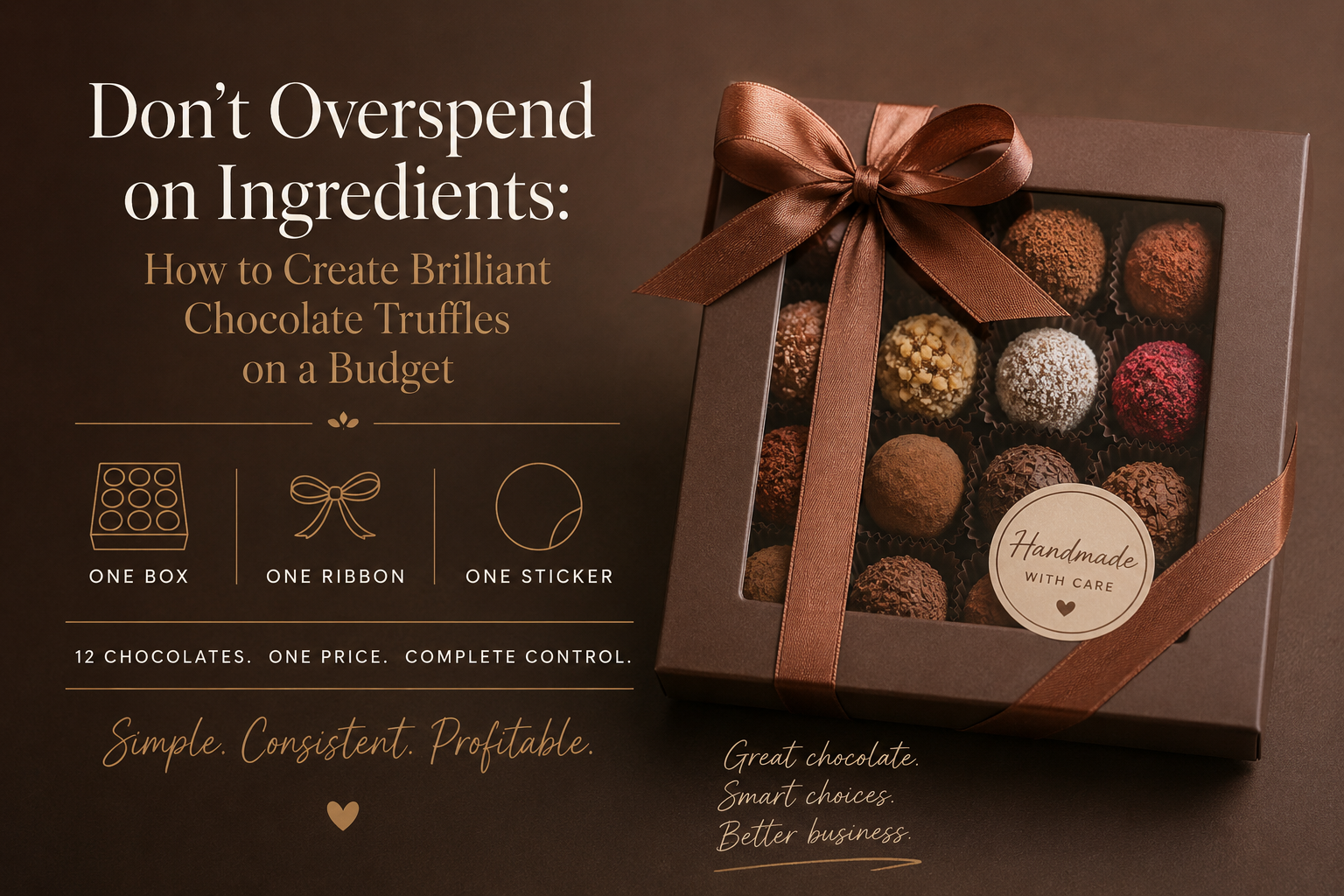
If everybody is making 12 chocolates, then give everybody a 12-chocolate box.
Not a larger box.
Not a selection of different boxes.
Not a pile of ribbons and the instruction to “help yourself”.
That is how costs disappear.
 Pre-make the packaging.
Have the boxes already assembled.
Cut the ribbon to length beforehand.
If you are using tissue, cups or liners, put them in before the workshop starts.
One delegate.
One box.
One branded sticker
One ribbon.
Twelve truffle cups
Twelve chocolates.
Done. It may sound controlling It is.
That is why it works.
Corporate workshops are supposed to feel generous, but that doesn't mean they should become an uncontrolled packaging buffet.
A few extra chocolates per person, another length of ribbon, another box because somebody wants one “for their partner” and suddenly your margin has quietly left the building.
Decide the offer before the event and stick to it.
If the package is twelve chocolates, then twelve chocolates is what goes home.
You can still make it look beautiful.
In fact, pre-prepared packaging usually looks better because every box leaves the room consistently finished.
And nobody spends the last fifteen minutes fighting with ribbon.
A Word About Allergens
This is the less glamorous part, but it matters.
Nuts.
Sesame.
Biscuits.
Malted products.
Milk powders.
Gluten.
Once you start laying these things out buffet-style, you need to think carefully about allergen control and cross-contact.
Label everything clearly.
Keep utensils separate.
Don't rely on people remembering what went into what.
Chocolate workshops should be memorable.
Preferably not because somebody needed an ambulance.
The Bigger Lesson
What I like about this kind of exercise is that it quietly teaches something important.
People often think chocolate work is about precision, expensive equipment and mysterious professional ingredients.
Sometimes that's true.
But sometimes it's a bowl of ganache, a jar of instant coffee and a packet of ginger biscuits.
And somebody takes a bite and says:
“That is actually really good.”
Exactly.
Because flavour doesn't care how much the ingredients cost.
It only cares whether the combination works.
And neither does a profitable workshop.
Twelve chocolates. One box. One ribbon.
A good experience.and enough margin left at the end to make you want to do it again.