
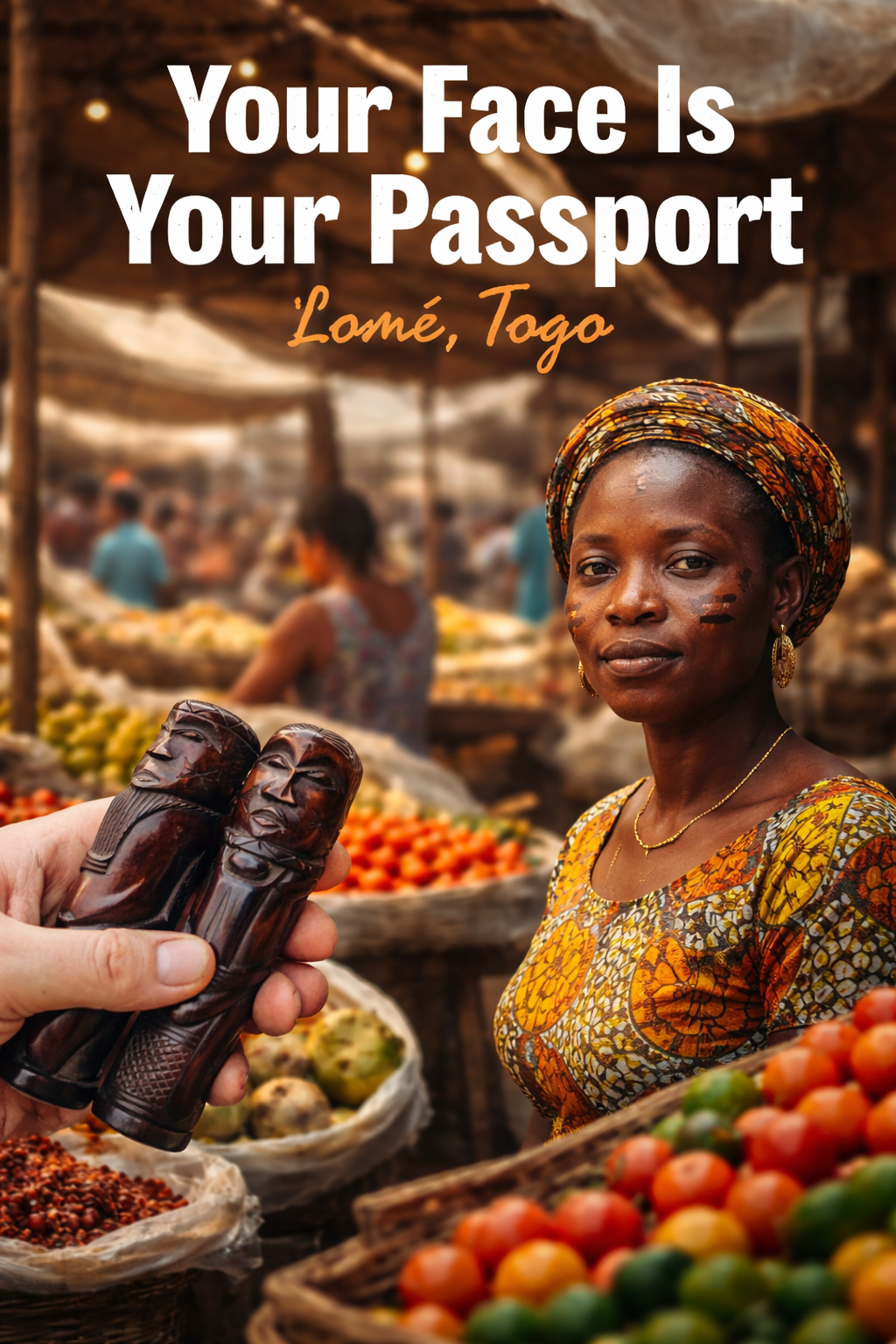
What a Morning in Lomé, Togo Taught Me About Chocolate, Identity and Origin
The old saying in Lomé goes something like this:
“Your face is your passport.”
It sounds poetic until someone says it with complete certainty.
Then you realise it isn’t poetry at all. It’s actual history.
The market was awake long before the sun had decided to show itself properly.
Dust drifted lazily beneath plastic sandals. Women arranged pyramids of tomatoes with almost mathematical precision.
Smoke curled from charcoal braziers being fanned with cardboard where fish crackled over glowing embers. Somewhere a radio argued with another radio, each competing for attention while motorbikes squeezed through gaps that barely existed. This is where real countries introduce themselves to travellers Not in airports or in hotel lobbies but In markets.
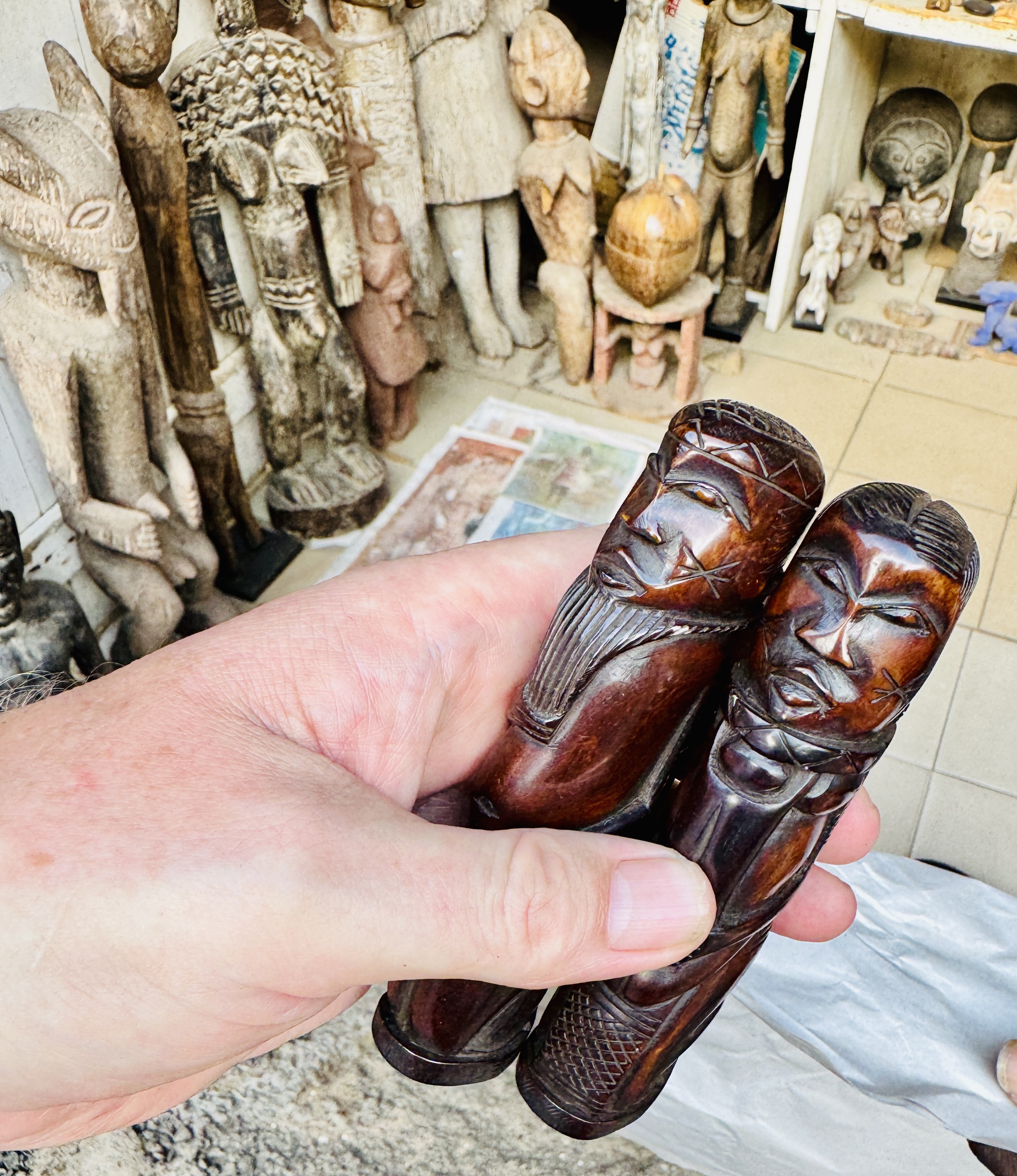
I was looking over two beautifully carved figures made from polished cow bone, their smooth dark surfaces interrupted by delicate facial markings, when I realised someone was watching me.
She wasn’t trying to sell me anything.
She simply stood there with quiet confidence, wrapped in wax print cloth the colour of ripe mangoes, then I noticed her cheeks,the same markings as the carvings
“You’ve noticed something,” she said her English was calm, measured, almost amused.
I held up one of the carvings, yes “The man selling these told me the markings were once like passports.”
She smiled no “Passports are for tourists.”
Then she gently touched her cheek. “This is for family.”
“My grandmother carried these same marks,” she said. “And her grandmother before her.”
Those lines had survived long before anyone drew borders across West Africa. Before someone in a distant office decided that one side would become Ghana and the other Togo.
“When I return to my village,” she told me, “the old women already know who I am.”
“They don’t need to ask for my papers.”
There wasn’t a hint of nostalgia in her voice.
Yes she still carried an identity card a voter registration card. A mobile phone that buzzed every few minutes with messages from modern life.
Borders stil exist.
Governments exist.
Paperwork exists.
But so does lineage.
“These marks,” she said quietly, “tell you where I began.”
That conversation stayed with me after I left the market.
Because chocolate travels with passports too.
Just not the kind most people ever see.
Most of the world’s cocoa leaves Africa stripped of its identity. packed into sacks.
Weighed.Graded.Loaded into containers.
Reduced to commodity codes, shipping documents and export certificates.
The story disappears somewhere between the farm gate and the factory.
But every cocoa bean carries memory.
The soil that fed it.
The rain that shaped it.
The fermentation that transformed it.
The hands that turned it every day beneath the sun.
The conversations shared over drying mats as evening settled across the village.
None of those things appear on an invoice.
Yet every one of them changes the flavour.
The chocolate industry loves the word traceability.
GPS coordinates.
Farm mapping.
Lot numbers.
QR codes.
What3words locations
They’re all valuable tools. Necessary ones.
But traceability without humanity risks becoming another way of forgetting.
Knowing where something was grown isn’t the same as understanding where it belongs.
That woman in the market never had to explain herself, her face already carried the answer.
And I found myself wondering…
What would happen if chocolate carried its identity with the same confidence?
Perhaps that’s why I’ve become so fascinated by the whole pod philosophy.
If we only value the bean, (18%) we tell only part of cocoa’s story.
The sweet pulp becomes waste.
The husk becomes waste.
The farmers’ knowledge becomes invisible.
The culture becomes a footnote.
Yet every part has value, every part has a purpose.
Every part tells us something about where chocolate truly begins.
Whole pod isn’t about sustainability, it’s about respecting the complete story.
As I walked back through the market, weaving between baskets of peppers and women balancing impossible loads on their heads, I realised I was leaving with more than a carved souvenir.
I was carrying a question.
One that has followed me across cocoa farms in Ghana, fermentation rooms in Togo, chocolate factories in Europe and kitchens around the world.
How do we allow chocolate to speak for the people and places that created it?
I’m still searching for that answer.
Which is probably why I keep travelling.
Why I Travel
People often assume I travel to discover chocolate, the truth is, I travel to discover the people behind it.
Whether I’m standing with cocoa farmers in Ghana, sharing meals in Togo, exploring markets in Peru or leading chefs through Europe’s great chocolate cities, every journey adds another chapter to chocolate’s story.
Chocolate has never been just an ingredient.
It’s history, It’s agriculture, culture, politics, memory.
But Most importantly, it’s people.
Those are the stories I love sharing through my Chocolate Safari® experiences, culinary tours and chef-led food journeys taking people beyond the tasting notes to meet the places, flavours and communities that make great food unforgettable.
Because the best food tours don’t simply show you what to eat.
They change the way you see the world.
About the Author
David Greenwood-Haigh is an award-winning chocolatier, international chocolate consultant, author and founder of Coeur de Xocolat. He works with cocoa producers, chefs, universities and hospitality organisations around the world, leading chocolate safaris, culinary experiences and educational workshops that connect people with the origins, culture and craftsmanship behind chocolate.
A Note on Scarification
Across many parts of West Africa, facial scarification has historically served as a visual language expressing lineage, community, status and belonging. Practices differed widely between ethnic groups and regions and should never be viewed as a single tradition.
Many communities no longer practise scarification due to changing social attitudes, urbanisation, colonial influence and the introduction of modern identification systems. For others, these markings remain an important expression of cultural heritage and family history.
This conversation took place in Lomé, Togo, and is shared with permission and respect. It reminded me that identity often exists beyond official documents. Chocolate, too, carries traces of where it
began if we’re prepared to look beyond the label.