
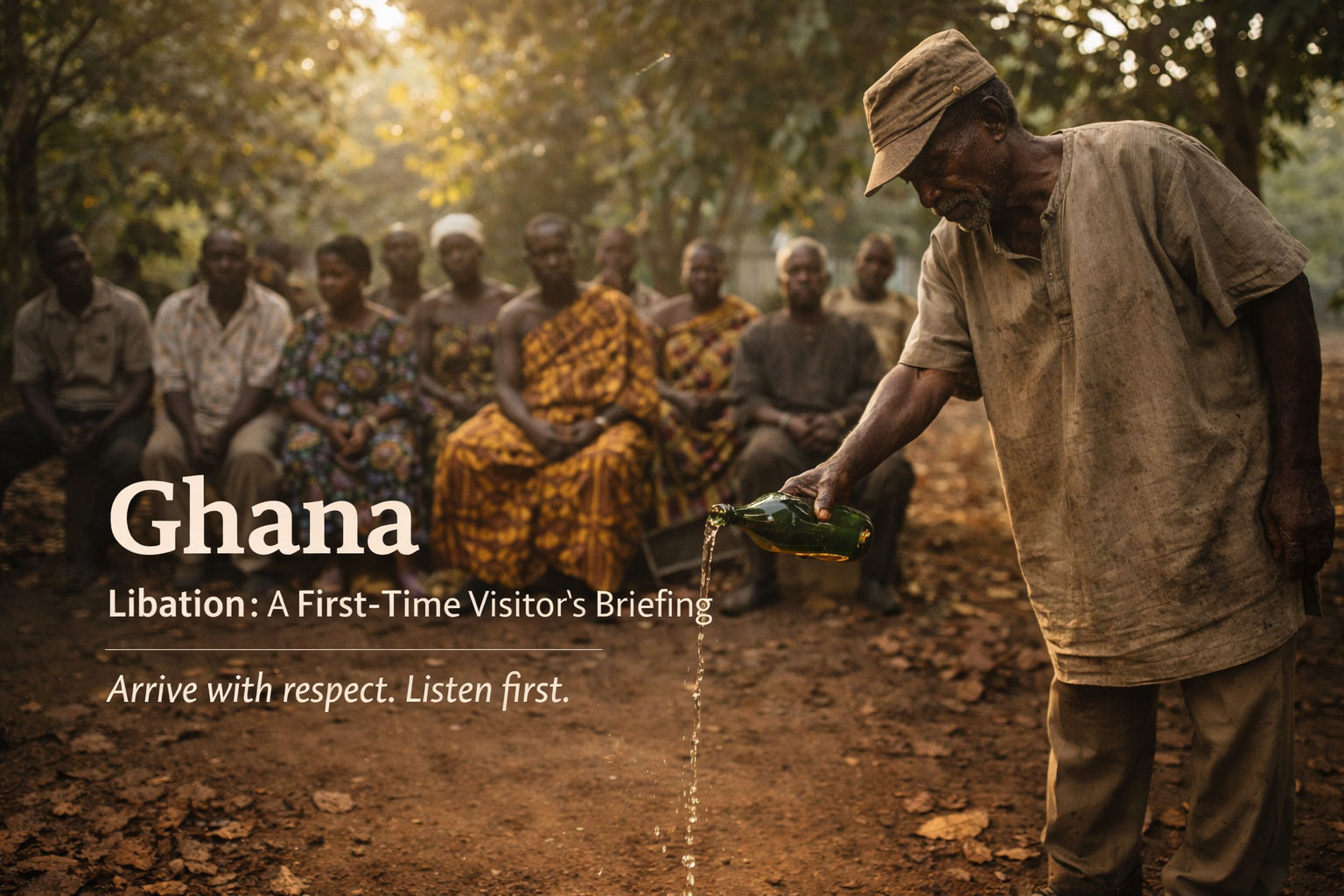
 There are moments when travel stops being about movement and starts being about listening.
In Ghana, libation is one of those moments.
It isn’t decorative. It isn’t theatre. And it was never meant to be protocol.
At its core, libation is a conversation first with the Supreme Being, the Creator God, and then with the ancestors who carried the land, the language, and the obligations that shaped the present. It is not something you add to an event. It is how you enter one.
I’ve stood quietly at gatherings where libation was poured properly not hurried, not amplified, not explained for outsiders and I’ve felt the temperature of the space change. Not in a mystical way. In a human one. The room slows. People stop performing themselves. Attention drops downward, toward the earth.
That’s the whole point.
A drink is poured onto the ground.
Names are spoken aloud.
Gratitude comes before requests.
Permission is asked before anything begins.
Nothing about libation is casual.
The ground matters.
The words matter.
The person speaking matters.
Traditionally, libation opens a gathering because it situates the living inside a long line of accountability. It reminds everyone present chiefs, politicians, farmers, visitors that decisions are not made in isolation. Authority is not owned. It is borrowed, and it can be withdrawn.
That understanding is what gives libation its weight.
From the outside, libation can look simple. A bottle. A pour. A few phrases spoken rhythmically.
But simplicity is not the same as looseness.
The logistics of libation are precise, even when they appear understated.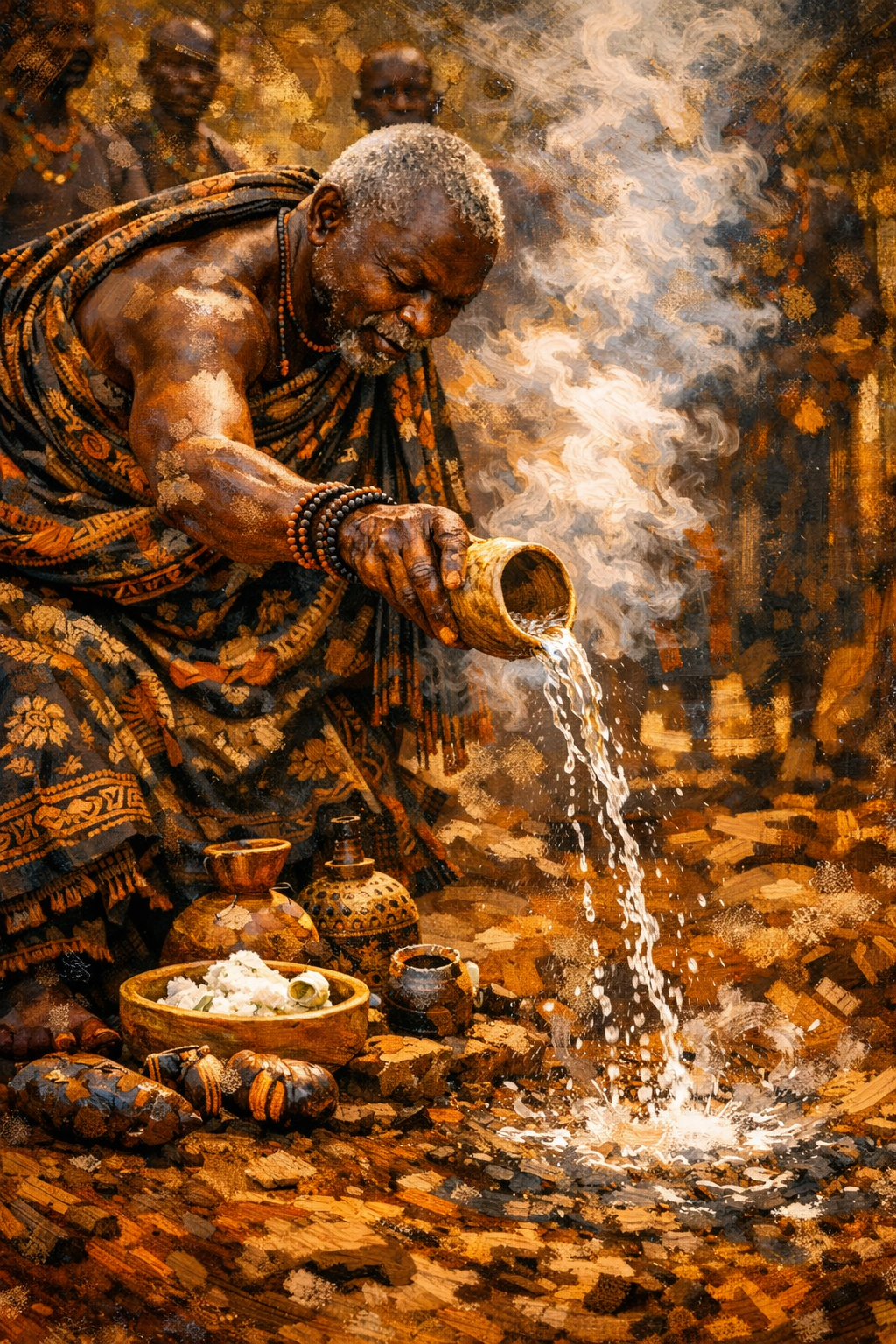
The person who pours is rarely chosen at random, raditionally, it is an elder, a family spokesperson, or a recognised custodian of tradition someone trusted to speak accurately on behalf of others.
Authority here dosent come from office, title, or microphone. It comes from memory, lineage, and responsibility.
That distinction matters more than most visitors realise.
The liquid itself water, palm wine, or local gin is selected for cultural appropriateness, not cost or prestige. It is poured directly onto the earth, never into a container, because the earth is the medium through which ancestors are addressed. The pour is slow and deliberate, often paused and repeated in stages as the address unfolds.
And the words are not improvised.
They follow a recognisable structure:
• acknowledgement of the Supreme Being
• invocation of specific ancestors, often by name
• explanation of why the gathering exists
• requests for guidance, protection, and clarity
Those present stand quietly. There is no applause. No interruption. No commentary. Libation is communal, even though only one person speaks.
Done properly, it humbles everyone in the space.
Not because it demands reverence, but because it places the present moment inside something much larger than itself.
Libation opens a gathering because it establishes orientation.
Before speeches, before negotiations, before decisions.
Libation answers a simple question: Who are we accountable to?
In a society where oral history carries weight, naming ancestors is not symbolic. It's practical. It establishes continuity, reminding everyone that actions today will be remembered tomorrow and judged.
That’s why libation has never been about spectacle. It isn’t designed to impress. It’s designed to align.
When done with integrity, libation pulls ego out of the room. It recentres the collective. It makes leadership feel provisional rather than permanent.
And that is precisely why it matters.
In recent years, parts of this practice have been bent out of shape.
I’ve seen libation performed as a public-facing ritual detached from lineage, context, and consent.
The bottle is present.
The ground is present.
The words sound familiar.
But something essential is missing, the focus has shifted.
When libation becomes a mandatory protocol rather than a sincere address, it thins.
When it is used to signal authority rather than humility, it distorts.
When the person pouring speaks for themselves rather than for the people, the conversation collapses.
In those moments, libation stops being relational and becomes performative.
It turns outward instead of downward.
Sometimes it becomes transactional something to be paid for, scheduled, or leveraged. Something added to an agenda rather than allowed to shape it. The logistics may look identical, but the meaning does not survive the shift.
The danger here isn’t modernity. It’s misplacement.
Libation was never designed to legitimise power. It was designed to restrain it.
When Performance Replaces Permission
One of the most telling changes is who libation is now performed for.
Traditionally, libation is not addressed to an audience. It is addressed to those who are absent but present all the same the ancestors, the custodians of memory, the moral witnesses.
When libation is performed primarily for cameras, dignitaries, or visiting officials, the axis flips. The act becomes a display rather than a dialogue.
And when that happens, something subtle but serious is lost.
Because libation is not about demonstrating tradition. It is about submitting to it.
What’s Been Lost and What Hasn’t
It would be easy to say that libation is disappearing. That would be inaccurate.
What has frayed is not the ritual, but the discipline around it.
Traditionally:
• Elders poured because they remembered names.
• Spokespeople spoke because they were trusted.
• The act belonged to the community, not the individual.
When office replaces elderhood, when protocol replaces belief, when spectacle replaces service, libation becomes hollow. But that hollowness does not come from the practice itself. It comes from misuse.
The ritual has not failed. People have.
And yet libation endures patient as the earth it is poured upon. It waits for those who understand that the act is not a performance for the living, but a dialogue with those who stand behind us, watching quietly.
That patience is part of its strength.
For those of us who move through Ghana as visitors whether as travellers, consultants, journalists, or guests libation can be easy to misunderstand.
It is not a cultural flourish.
It is not an opening ceremony.
It is not something to photograph and move past.
It is a moment of alignment.
The most respectful thing a visitor can do during libation is nothing. Stand still. Listen. Allow the moment to belong to the people for whom it has meaning.
Understanding libation doesn’t require belief. It requires restraint.
What strikes me most about libation, especially in contrast to modern leadership culture, is how uncomfortable it makes unchecked authority.
Libation insists on continuity in a world obsessed with immediacy. It demands that beginnings begin properly. It reminds leaders quietly but firmly that authority is conditional, temporary, and answerable.
There is no triumphalism in libation. No declarations of dominance. Only requests.
Guidance.
Protection.
Clarity.
And perhaps most importantly: permission.
Recovering Intention Without Fossilising Tradition
To recover libation is not to freeze it in time or place it behind glass. Cultures survive because they adapt. But adaptation without intention becomes erosion.
What libation requires is not preservation, but honesty.
Who is speaking?
On whose behalf?
And to whom?
When those questions are answered with integrity, libation still does what it has always done: it grounds. It aligns. It humbles.
It does not divide.
It does not elevate one voice above others.
It situates all voices within a longer story.
That is its power.
Because Libation Was Never About Power
It was about permission.
Permission to gather.
Permission to speak.
Permission to act.
And in a world increasingly comfortable with taking without asking, that may be exactly why it still matters.