
 Chocolate history has a problem.
Tell a story often enough and, after a while, people stop asking whether it is actually true.
A traveller visits a distant kingdom. An exotic drink appears,but a king tastes something mysterious. Dates blur, continents shrink and five hundred years disappear somewhere between one paragraph and the next.
Chocolate is particularly good at attracting these stories.
One of them involves Ibn Battuta, perhaps the greatest traveller of the medieval Islamic world, and the suggestion that he encountered chocolate while travelling through West Africa.
It is a wonderful story, there is just one problem, it almost certainly didn’t happen.
And once you remove the chocolate, the real story becomes considerably more interesting.
Who was Ibn Battuta?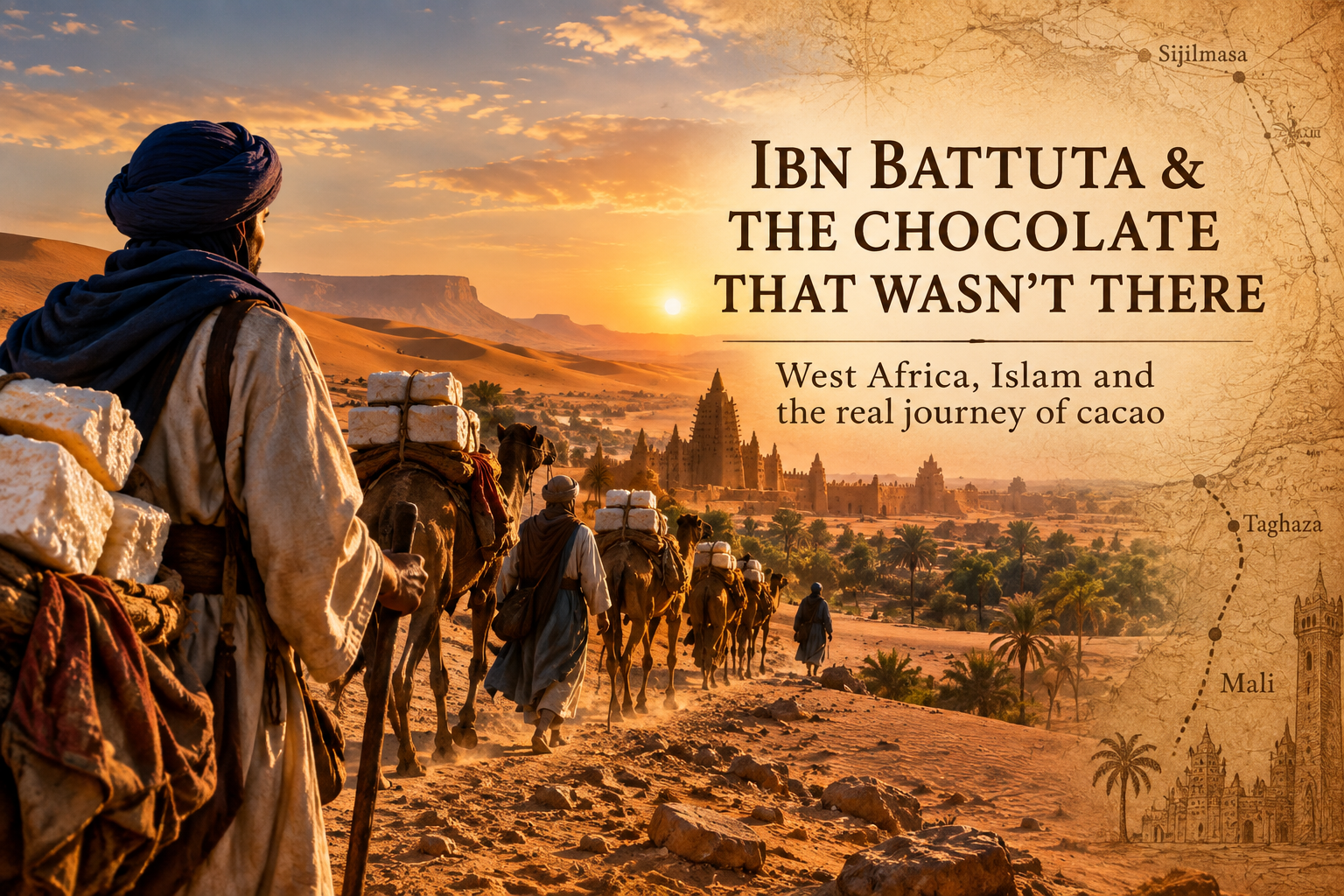
Ibn Battuta was born in Tangier, Morocco, in 1304, in 1325, when he was about 21, he left home intending to perform the Hajj, the pilgrimage to Mecca.
Most people would have considered Tangier to Mecca quite enough of a journey, Ibn Battuta apparently didn't
Over roughly three decades he travelled through North Africa, Egypt, Arabia, Persia, East Africa, Anatolia, Central Asia, India and other parts of the medieval world.
Eventually he returned to Morocco.
His travels survive through the work generally known as the Rihla, meaning a journey or travel account.
We should immediately add one historian’s warning label.
The Rihla was not a modern travel diary scribbled down every evening beside the campfire. Ibn Battuta related his experiences after his return to Morocco, and the scholar Ibn Juzayy helped shape them into the literary work that survives.
Like almost every medieval source, it needs to be read critically.
Dates can be troublesome. Some passages may contain literary borrowing. Historians continue to debate elements of his enormous itinerary.
But his account of Mali is extremely important.
Historian N. Levtzion described Ibn Battuta’s account of his journey through Mali as a “first-rate historical document”, one of the most important Arabic sources for understanding the Mali Empire at its height.
And this is where our chocolate story begins, or rather, where it doesn’t.
Crossing the Sahara
In 1352, Ibn Battuta headed south from Morocco towards the Mali Empire, forget any idea of a lone traveller wandering into an unknown wilderness.
He was following established commercial routes.
The Sahara was difficult, dangerous and enormous, but it was not an empty barrier between two disconnected worlds.
It was crossed by merchants, guides, scholars, pilgrims and caravans, gold moved north, salt moved south.
So did textiles, manufactured goods, ideas, stories, religion and information.
Ibn Battuta travelled from Sijilmasa, an important Moroccan trading centre, southwards across the desert.
One of his most memorable stops was Taghaza, and Taghaza was about salt.
A town made of salt
I have spent much of my career talking about cacao as a commodity.
Beans in sacks, Prices, trade, farmers, Merchants and Ports.
Value moving from one pair of hands to another.
Reading Ibn Battuta reminds us that long before West Africa became associated with cocoa, other commodities were already shaping international trade.
At Taghaza, salt was king.
Ibn Battuta described a place where even buildings were constructed using slabs of salt.
Large blocks were cut, loaded onto camels and carried south into the Mali Empire.
The further south they travelled, the more valuable they became.
This was not primitive barter on the edge of civilisation.
It was international commerce.
Ibn Battuta was travelling through one of the great trading systems of the medieval world.
And there was still not a cacao bean in sight.
What Ibn Battuta actually ate
This is the part I find fascinating.
Ibn Battuta was not merely interested in rulers and mosques.
He noticed food.
Sometimes approvingly.
Sometimes with the sort of miserable traveller’s judgement that still sounds familiar nearly seven centuries later.
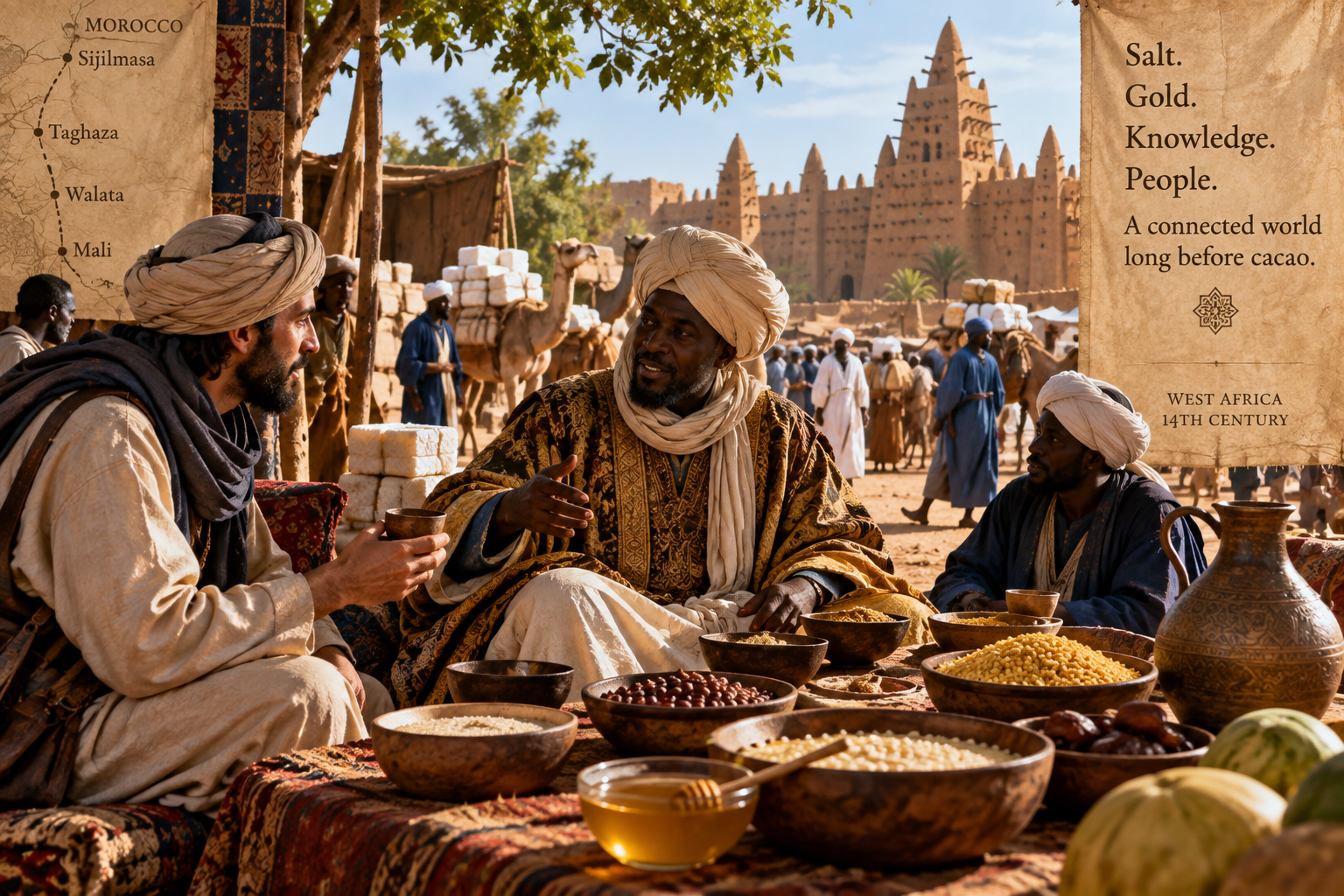
At Walata, after crossing the Sahara, Ibn Battuta was invited to a meal.
He describes being served pounded millet mixed with honey and milk in a calabash.
He was distinctly unimpressed.
His hosts, on the other hand, regarded it as excellent hospitality.
Anyone who has travelled and eaten with local communities will recognise the scene immediately.
You arrive with your own expectations.
Your hosts have theirs.
The food sitting between you carries far more meaning than the ingredients alone.
Elsewhere in his West African account, Ibn Battuta records foods including millet, milk, chickens, rice, grains used for couscous and porridge, beans and honey.
These details give us something precious.
They allow us to glimpse food culture in fourteenth-century West Africa through the eyes of someone who was actually there.
What he never describes is equally important.
There is no cacao, no cacao beans, no chocolate drink.
No mysterious bitter cup secretly travelling across medieval Africa.
Nothing.
And historically, that makes perfect sense.
Because cacao was still on the other side of the Atlantic
Cacao is an American plant.
Its deep history belongs to the tropical Americas, where Indigenous peoples cultivated, processed and consumed cacao long before Europeans arrived.
Ibn Battuta was travelling through Mali in 1352–1353.
At that point the cacao traditions of the Americas and the societies of West Africa existed on opposite sides of an Atlantic world that had not yet been connected by the sustained exchanges that followed European expansion after 1492.
So a bowl of chocolate appearing in Ibn Battuta’s fourteenth-century Mali would require extraordinary evidence.
I cannot find any credible evidence for it.
And Ibn Battuta himself provides none.
Mali before cocoa
This matters for another reason.
When we think about Ghana and neighbouring West African countries today, cacao can dominate the picture.
Cocoa farms.
Fermentation heaps.
Drying tables.
Sacks of beans.
Warehouses.
Ports.
Chocolate factories thousands of miles away.
I have walked through cocoa-growing communities where cacao is woven into everyday life and the economy.
It can feel as though the crop has always been there, it hasn’t.
Ibn Battuta gives us a view of West Africa centuries before cacao became part of that landscape.
And what do we see?
Gold. Salt. Millet. Honey. Farmers. Merchants.
Islamic scholars. Courts. Trade routes. Hospitality. Political systems.
A sophisticated commercial world functioning quite successfully without chocolate.
That is important.
Africa didn't need cacao to connect it to global trade, the connections already existed.
Ibn Battuta reaches Mali
According to the surviving account, Ibn Battuta arrived at the capital associated with the Mali Empire on 28 June 1352 and departed on 27 February 1353.
The precise identification of some locations in his itinerary remains debated by historians, which is another reason not to turn medieval travel accounts into neat modern maps without qualification.
He encountered the court of Mansa Sulayman, brother of the famous Mansa Musa.
That name is important.
Mansa Musa had made his celebrated pilgrimage to Mecca in 1324–1325, travelling through Cairo with such wealth that accounts of Mali’s gold became famous far beyond West Africa.
By the time Ibn Battuta arrived a generation later, Mali was firmly connected to a wider Islamic intellectual and commercial world.
He encountered judges, scholars, mosques and Muslim religious practice.
He also encountered customs he disliked intensely.
A traveller is never neutral
This is another reason I enjoy reading Ibn Battuta.
He can be marvellous.
He can also be infuriating.
He judged.
Frequently.
Practices that did not fit his expectations as a North African Muslim jurist could attract considerable criticism.
His reaction to his reception at Walata is a perfect example. Presented with millet, honey and milk, he seems less interested in the generosity of his hosts than in the fact that the meal failed to meet his expectations.
Elsewhere he criticises social practices and clothing.
That does not make his account useless.
Quite the opposite.
It reminds us that travel writing is rarely neutral.
Every traveller carries baggage that never appears on the camel.
Religion.
Class.
Culture.
Taste.
Prejudice.
Expectation.
Ibn Battuta was describing West Africa, but sometimes he was also telling us a great deal about Ibn Battuta.
So when did cacao actually arrive in West Africa?
Now we jump forward roughly five centuries.
Cacao cultivation moved gradually beyond the Americas as European empires carried plants around their colonial networks.
According to the International Cocoa Organization, Amelonado cacao was planted on Príncipe in 1822, São Tomé in 1830 and Fernando Po now Bioko in Equatorial Guinea in 1854.
From there the story begins to connect with modern Ghana.
Ghana Cocoa Board records earlier attempts to establish cacao in what was then the Gold Coast, including Dutch missionary planting in 1815 and Basel missionaries at Aburi in 1857.
But commercial expansion is closely associated with Tetteh Quarshie.
Quarshie, a blacksmith from Osu, had worked on Fernando Po. He returned in 1879 with Amelonado cacao planting material and established a farm at Akwapim Mampong.
Farmers obtained planting material from his farm and cacao cultivation spread.
Think about that date. 1879.
Ibn Battuta was travelling through Mali in 1352.
The gap between those stories is more than five centuries.
That is why we need to be careful when we talk about “African chocolate history”.
Africa has an ancient food history.
Africa has an ancient agricultural history.
Africa has an ancient trading history.
But West Africa’s cacao industry is comparatively recent.
Those are not contradictory statements.
They are simply different histories.
What about chocolate and the Islamic world?
This is where another myth needs handling carefully.
Chocolate certainly reached societies within the wider Islamic world, but pinning down exactly when and where is more difficult than popular chocolate timelines sometimes suggest.
The Ottoman Empire provides an interesting example.
Historian Yavuz Köse, who has researched chocolate in the Ottoman Empire, argues that chocolate was probably available there by the late seventeenth century, although it attracted much less attention than coffee or tobacco.
That distinction matters.
Coffee became enormous.
Chocolate did not.
Coffeehouses became part of Ottoman social culture, politics and conversation.
Chocolate remained far more unusual.
One particularly intriguing documented episode came in 1783.
Research using Ottoman archival records describes diplomatic gifts sent by the Spanish king Carlos III to the Ottoman Sultan Abdülhamid I.
Among the gifts were reportedly four crates of chocolate and six packages of cocoa.
The Ottoman documents apparently struggled even to describe the unfamiliar product, comparing it with coffee.
Now that is a chocolate story I can believe.
Not because it sounds romantic.
Because we have evidence.
Coffee had already won the argument
By the time chocolate began appearing in Ottoman circles, coffee had centuries of momentum behind it.
Chocolate entered a world where another dark, bitter, stimulating drink was already deeply embedded.
That probably helps explain why chocolate didn't occupy the same cultural space.
Coffee had the coffeehouse, and had a ritual.
Coffee had conversation, and politics.
Chocolate was the newcomer.
An expensive foreign curiosity arriving from a plant grown thousands of miles away.
There is an interesting lesson here for anyone studying food.
Ingredients don't become culturally important simply because they arrive.
They have to find somewhere to belong.
From salt to cacao
And that brings me back to Ibn Battuta.
Imagine two journeys.
The first takes place in 1352.
A caravan moves south across the Sahara.
Camels carry salt, merchants travel towards one of the richest empires in Africa.
Millet, honey and milk are served to a tired Moroccan traveller who complains about the hospitality.
Gold moves north.
Islamic scholarship moves in every direction.
Cacao is nowhere to be found.
Now move forward five hundred years.
Cacao trees spread through islands off the African coast and eventually into the forests of the Gold Coast.
Farmers learn how the crop behaves.
Trees are planted.
Pods are harvested.
Beans are fermented and dried.
A new commodity begins moving through another global trading system.
Eventually Ghana becomes one of the names most closely associated with cocoa anywhere in the world.
Same continent.
Different centuries.
Different commodity.
Different story.
And perhaps that is the real lesson
We sometimes try too hard to make chocolate ancient everywhere.
Perhaps we think it gives the subject greater importance, it doesn’t need it.
Chocolate’s genuine history is complicated enough.
The more interesting story is not that Ibn Battuta drank chocolate in medieval Mali.
He didn’t, as far as any credible evidence currently shows.
The interesting story is that he allows us to see West Africa before cacao.
A region already producing food and trading internationally.
Already connected intellectually and commercially with North Africa and the wider Islamic world.
Already possessing powerful states, scholars, farmers, merchants and complex societies.
Five centuries later cacao entered that landscape and began another extraordinary chapter.
Today, when I stand on a cocoa farm in West Africa, it is easy to see the cacao tree and imagine it as part of an ancient African landscape.
Ibn Battuta reminds me otherwise.
Sometimes understanding chocolate means looking at the things that were there before it.
Salt.
Gold.
Millet.
Honey.
Faith.
Trade.
People.
And not a cocoa bean in sight.
Sources and further reading
This article draws particularly on Ibn Battuta’s surviving account of his journey through Mali, including the translated excerpts hosted by Fordham University’s Medieval Sourcebook; historian N. Levtzion’s work on the medieval kings of Mali; research into Ibn Battuta’s disputed West African itinerary; Ghana Cocoa Board’s history of commercial cocoa cultivation in Ghana; the International Cocoa Organization’s history of cacao’s movement into Africa; and Yavuz Köse’s peer-reviewed research into chocolate in the Ottoman Empire.
Research note: I have deliberately not repeated claims that Ibn Battuta encountered cacao or chocolate in Mali because I cannot confirm them from credible historical evidence. The documented chronology of cacao cultivation in West Africa strongly contradicts that claim.
Here’s the full SEO and presentation package for the post.
SEO title: Ibn Battuta, Islam and Chocolate: The True History of Cacao in West Africa
H1 tag: Ibn Battuta, Islam and the Chocolate That Wasn’t There
Meta description: Did Ibn Battuta encounter chocolate in medieval Mali? Explore the real history of Ibn Battuta, Islam, West African trade and the much later arrival of cacao.
Meta keywords: Ibn Battuta, history of chocolate, cacao history, chocolate and Islam, Mali Empire, Mansa Musa, Mansa Sulayman, West African cocoa, Ghana cocoa history, history of cacao, Islamic food history, medieval Mali, Tetteh Quarshie
Navigation title: Ibn Battuta and Chocolate
Navigation short description: What did Ibn Battuta really encounter in medieval Mali? A journey through salt, gold, Islam, food and the chocolate that wasn’t there.
Banner heading: Ibn Battuta, Islam and the Chocolate That Wasn’t There
Banner text: In 1352 Ibn Battuta crossed the Sahara into the Mali Empire. He found gold, salt, millet, honey, scholars and powerful rulers — but no chocolate. So where does cacao really fit into the story?
URL slug: ibn-battuta-islam-history-chocolate-west-africa
For the hero image, I would avoid showing Ibn Battuta holding chocolate, because that would undermine the whole point of the article. A much stronger visual would be a cinematic medieval Saharan caravan: camels crossing golden desert dunes carrying salt slabs, a North African traveller in fourteenth-century clothing, hints of West African trade and manuscript-map textures, with no cacao or chocolate visible.
The overlay could simply read:
West Africa, Islam and the real journey of cacao
For SEO structure inside the article, I’d also use headings such as Who Was Ibn Battuta?, What Did Ibn Battuta Eat in Mali?, Mali Before Cocoa, When Did Cacao Reach West Africa?, Chocolate and the Islamic World, and From Salt Roads to Cocoa Farms. Those naturally capture the searches people are likely to make without making the page sound artificially written for Google.
One small change I would make to the published article: spell his name consistently as Ibn Battuta, not “Iban”. That is the standard English transliteration used by major reference works.
Arab traveller Ibn Battuta described seeing chocolate being consumed in Mali.
read more here about chocolate and faith