
If you are new to tasting chocolate, start with my free Chocolate Tasting Guide. It takes you through the process step by step looking, listening, smelling, tasting and allowing the chocolate to develop on the palate so you can begin building tasting notes with confidence.
A chocolate tasting journal helps you remember what you taste, develop your flavour vocabulary, compare cacao origins and discover your personal preferences. By recording aroma, texture, flavour, finish, origin and the story surrounding each chocolate, tasting becomes a record of your journey rather than a moment you eventually forget.
There is something a bit ridiculous about standing in front of a piece of chocolate with a notebook.
I know.
You unwrap the bar. You look at it, sniff it, break it in half and listen to the snap like some sort of cocoa-obsessed safecracker.
Then you write things down.
Red fruit. Tobacco. Roast. Citrus. Maybe leather. Maybe not.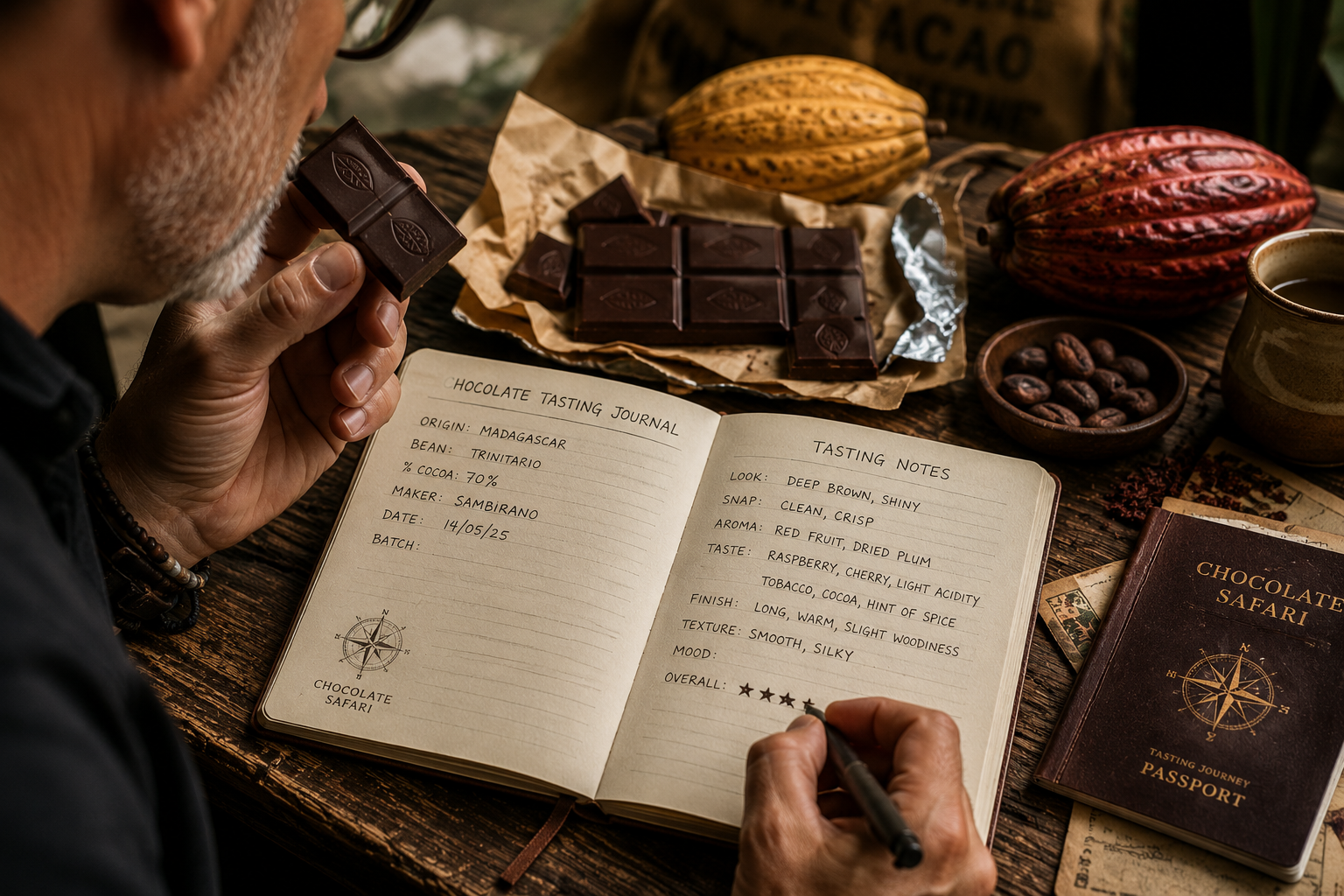
Anyone watching from across the room might reasonably think that you have taken chocolate far too seriously.
They may even be right.
But here's the problem.
If you don’t write it down, you forget.
And once you start travelling through the world of chocolate properly travelling through it forgetting becomes expensive.
Not financially.
Experientially.
Because the first time somebody puts a genuinely extraordinary chocolate in front of you, something shifts.
Maybe it was made in Madagascar.
Maybe Ecuador.
Maybe Ghana.
Maybe it came from a tiny factory you nearly walked past because the sign outside looked terrible.
Maybe a farmer broke open a cacao pod with a machete and handed you a seed still covered in white pulp.
You taste it.
You think wow
Then six months later someone asks what it tasted like.
And you say: “Fruity.” Brilliant.
An entire sensory experience reduced to one useless adjective.
That is why you keep a journal.
Memory is a terrible tasting tool
Human beings have an enormous capacity for believing we will remember things.
We won’t.
I have tasted chocolate in factories, hotel kitchens, classrooms, competitions, cacao farms and places where the temperature was high enough to turn tempering chocolate into an act of optimism.
At the time, every detail seems unforgettable.
The smell of fermenting cacao.
The heat. The noise. The farmer standing beside you. The ridiculous taxi journey it took to get there. The chocolate itself.
Then life moves on, flights, emails. Another tasting. Another bar. Another country.
And slowly the details disappear.
A notebook stops that happening.
Not perfectly.
But enough.
Eating chocolate and tasting chocolate are not the same thing
There is nothing wrong with eating chocolate.
Sometimes you want chocolate and you eat the bloody thing.
No analysis.
No flavour wheel.
No philosophical enquiry into fermentation.
Perfectly acceptable.
But tasting is different.
Tasting requires attention.
You look first. Is it pale? Dark? Red-brown? Almost black? Is the surface glossy?
Does it look like somebody cared?
Then you touch it.
You break it.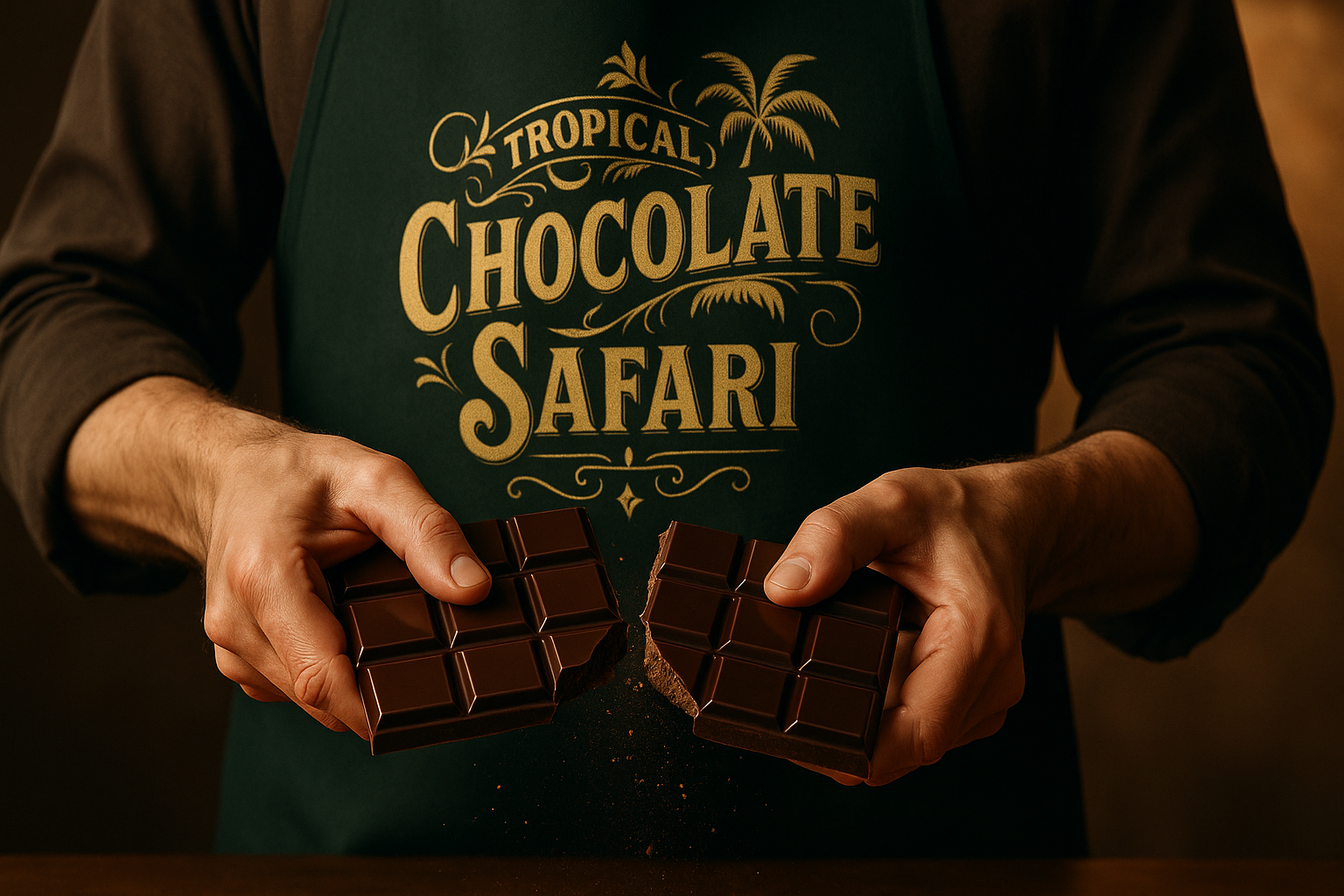
A clean snap can tell you something.
So can a disappointing bend.
Then you smell it.
And this is where things start getting interesting.
Chocolate can smell of things that have absolutely no business being inside a chocolate bar.
Flowers. Red berries. Banana. Tobacco. Wood. Coffee. Mushrooms. Caramel. Smoke. Spice. Sometimes cheese.
Occasionally something you would rather not identify.
Then you taste.
And if you are patient, the chocolate changes. The flavour at the beginning is not necessarily the flavour at the end.
That is why writing helps.
It forces you to stay with it. Your vocabulary gets better most people begin with the same collection of words.
Nice, Bitter, Sweet, Strong. This is understandable.
Nobody arrives in the world knowing how to describe flavour.
Then you taste more.
You start writing things down.
And “fruity” becomes “berry”.
Berry becomes “raspberry”.
Then perhaps:
Sharp raspberry acidity, followed by roasted cocoa and a slightly woody finish.
You haven’t grown new taste buds.
But You have learned to pay attention.
There is a difference.
You start discovering what you actually like
Here is another uncomfortable truth.
People are very good at liking what they think they are supposed to like.
Particularly around expensive food.
Someone hands you an 85% single-origin bar wrapped in handmade paper and starts talking about genetics, altitude and fermentation.
You feel almost obliged to enjoy it.
Your notebook doesn’t care.
You can write: Beautiful packaging. Fascinating story. Didn’t particularly enjoy the chocolate.
That is useful.
Because after twenty, thirty or fifty tastings, patterns appear.
You might discover that you love bright acidic chocolates, or hate them.
You may keep returning to nutty, roasted profiles.
You might find that the 60% bar you nearly ignored gave you far more pleasure than the supposedly serious 90%.
Good.
That is your palate becoming your palate.
Cocoa percentage is not a quality score
This one deserves writing down in very large letters.
MORE COCOA DOESN'T AUTOMATICALLY MEAN BETTER CHOCOLATE.
There.
I feel better.
The number on the wrapper tells you something.
It doesn't tell you everything.
A chocolate maker can take extraordinary cacao and ruin it.
Another can take something seemingly modest and make something wonderful.
Genetics matter. Fermentation matters. Drying matters.
Roasting matters. Conching matters.
Recipe matters. Skill matters.
Percentage is one piece of information.
Your tongue gets the final vote.
A chocolate bar has its own address
Not just its physical what3words
This is where chocolate becomes much more interesting than confectionery.
Chocolate comes from somewhere.
Actual somewhere.
A landscape.
A climate.
A community.
People.
Cacao doesn't begin its life in a stainless-steel factory, it starts on a tree.
Often somewhere hot, humid and far removed from the polished shop where the finished bar is eventually sold.
When you write down an origin, you begin connecting the finished chocolate with the place that produced it.
Ghana, Togo, Madagascar, Peru, Venezuela, Ecuador, São Tomé.
They stop being decorative words on packaging and become part of your memory.
And if you are fortunate enough to travel to cacao-growing countries, those names eventually acquire faces.
That changes everything.
Sometimes the note has nothing to do with flavour
Some of my favourite tasting memories could never be captured by writing:
citrus, roast, nuts, long finish.
The important detail might be:
Tasted with the farmer who grew the cacao.
Or: Bought from a tiny shop after walking three miles in the rain.
Or: Tasted in a factory while the chocolate was still warm.
Or: Shared with somebody I will probably never meet again.
Food has always been about more than flavour.
Context matters.
People matter.
Place matters.
A journal gives you somewhere to record that.
You start trusting yourself
This is perhaps the biggest change.
At tastings, people regularly look at me and ask:
“What should I be tasting?”
There is a temptation for experts to answer that question.
Strawberries.
Hazelnuts.
Jasmine.
Black tea.
Whatever.
But once I tell you what I taste, there is a danger that you start tasting my chocolate rather than yours.
Far better to taste first.
Write first.
Think first.
Then compare.
Over time something happens.
The question changes.
Instead of asking:
“What am I supposed to taste?”
you begin saying: “This is what I taste.”
That is the point.
The journal becomes a passport
At first it is just paper.
Empty boxes.
Blank lines.
A few prompts.
Then you start filling it.
A chocolate from Peru.
Another from Ghana.
A maker discovered in Paris.
A strange bar someone gave you at a food festival.
A brilliant pairing.
A terrible pairing.
A chocolate you expected to hate.
A chocolate you expected to love.
Pages accumulate.
And eventually the notebook becomes something else.
A record of where you have been.
Not simply geographically.
Sensory travel counts too.
You start seeing your own journey.
The origins you keep returning to.
The flavours you have learned to recognise.
The makers who surprised you.
The things you used to believe about chocolate that turned out to be nonsense.
That is why I created the Chocolate Safari® Tasting Journal.
Not to tell people what chocolate should taste like.
Quite the opposite.
To give people somewhere to discover what chocolate tastes like to them.
So write on the pages.
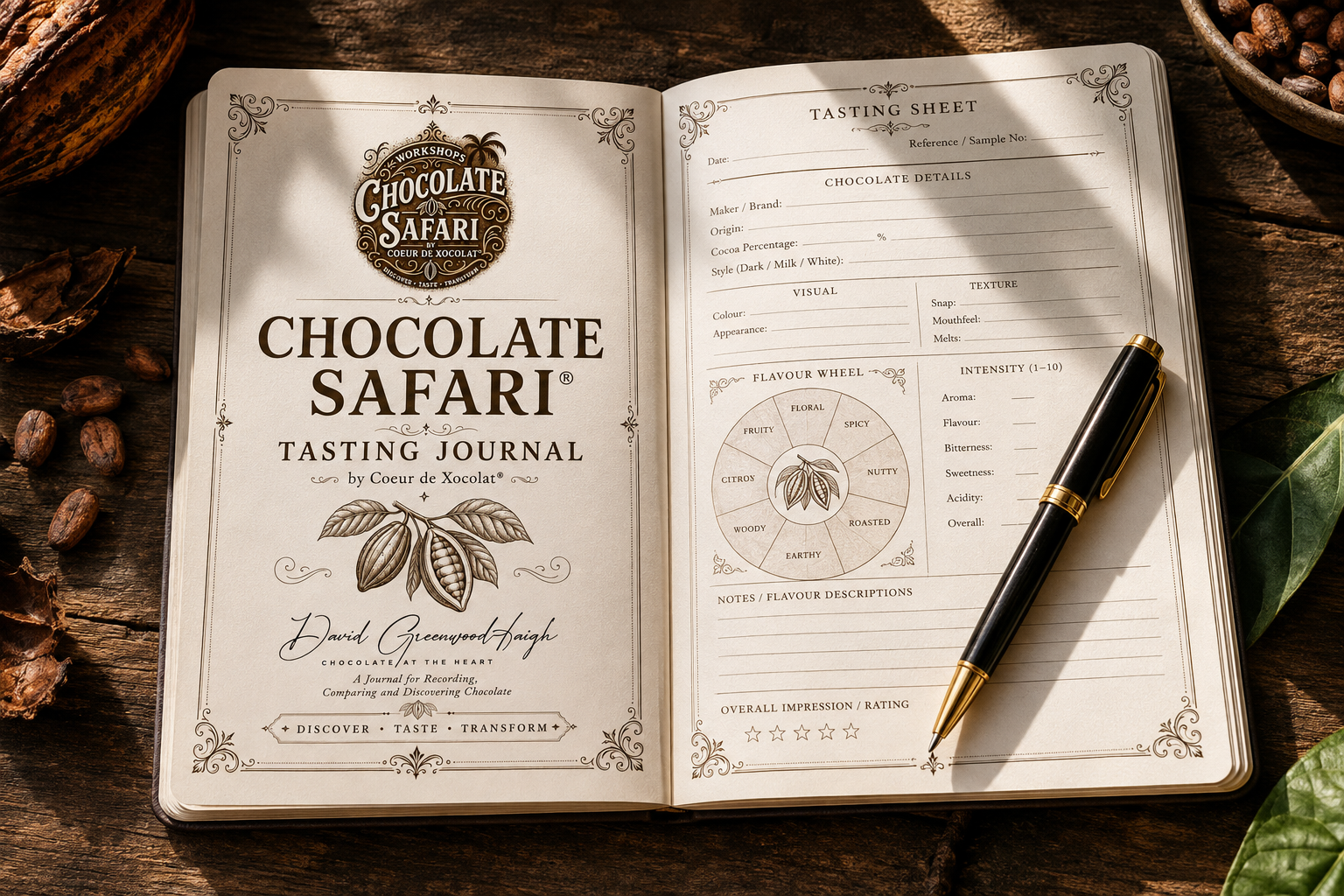
Make mistakes. Cross things out. Disagree with the flavour notes on the packet. Taste something expensive and hate it. Taste something cheap and fall in love with it.
Record the people. Record the places Record the surprises
Because eventually those pages become more than tasting notes.
They become your chocolate journey.
And that, frankly, is much more interesting than simply remembering whether you liked the bar.
Discover. Taste. Transform.