
Cacao and cocoa come from the same plant: Theobroma cacao.
Despite what you may have read online, there is not a universally accepted rule that “cacao” means raw or unprocessed while “cocoa” means roasted or processed.
The two words are frequently used interchangeably, and the word printed on a packet does not, by itself, tell you how the product was processed, how good it is, or whether it is healthier.
Confused? You’re certainly not alone.
As a chocolatier, chef and chocolate consultant, this is one of those questions I get asked again and again:
What is the difference between cacao and cocoa?
The short answer is: far less than the marketing might have you believe.
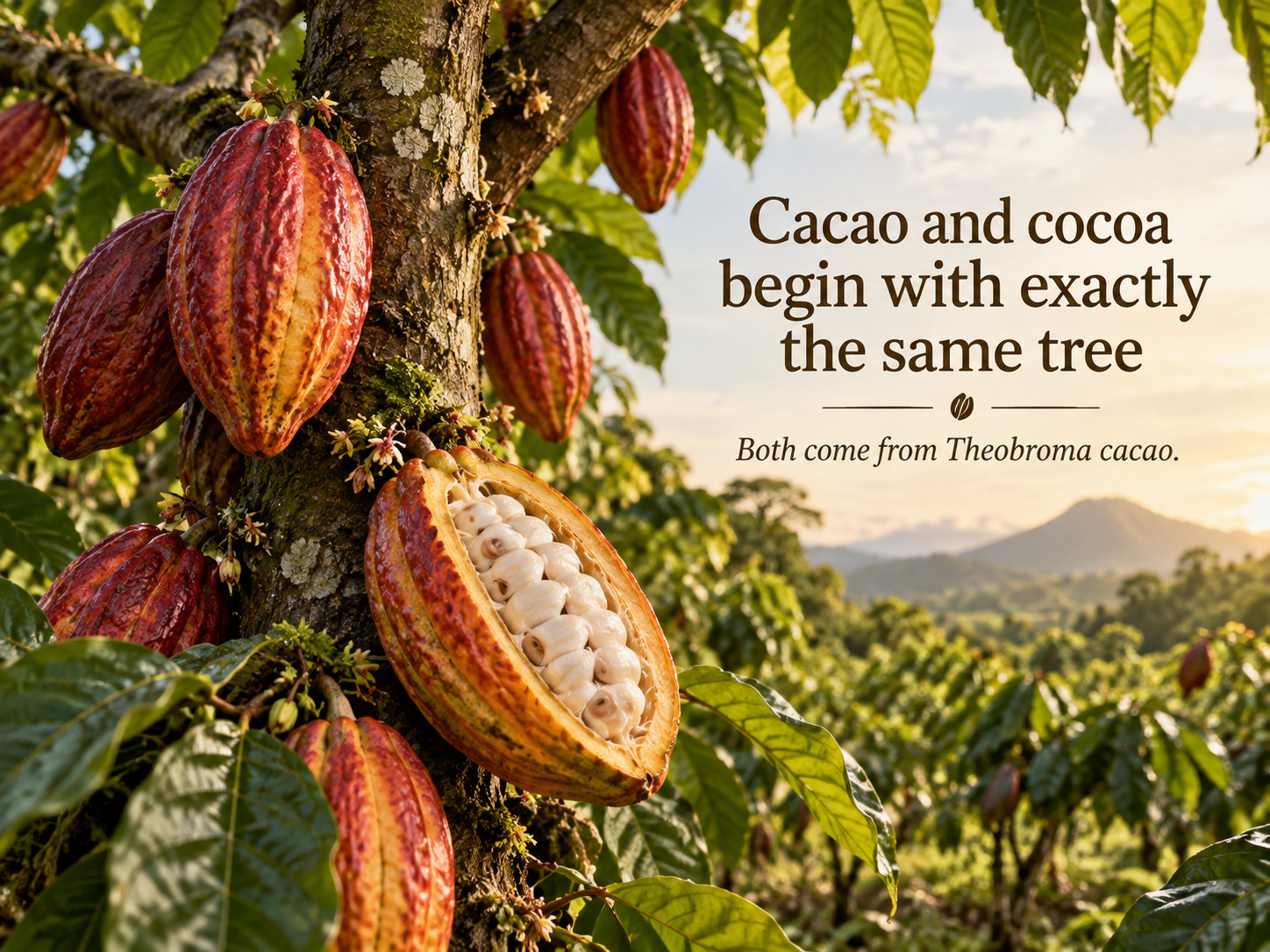
Cacao and cocoa begin with exactly the same tree
Chocolate begins with a remarkable tropical tree called Theobroma cacao.
Its colourful pods grow directly from the trunk and larger branches. Break open a ripe pod and you discover rows of seeds surrounded by a sweet, sticky white pulp.
Those seeds are what we commonly call cacao beans or cocoa beans.
And already we have our first problem.
One producer may call them cacao beans.
Another may call exactly the same thing cocoa beans.
Neither term automatically tells you whether they have been fermented, dried, roasted or otherwise processed.
That is why I always tell people to look beyond the word on the front of the packet.
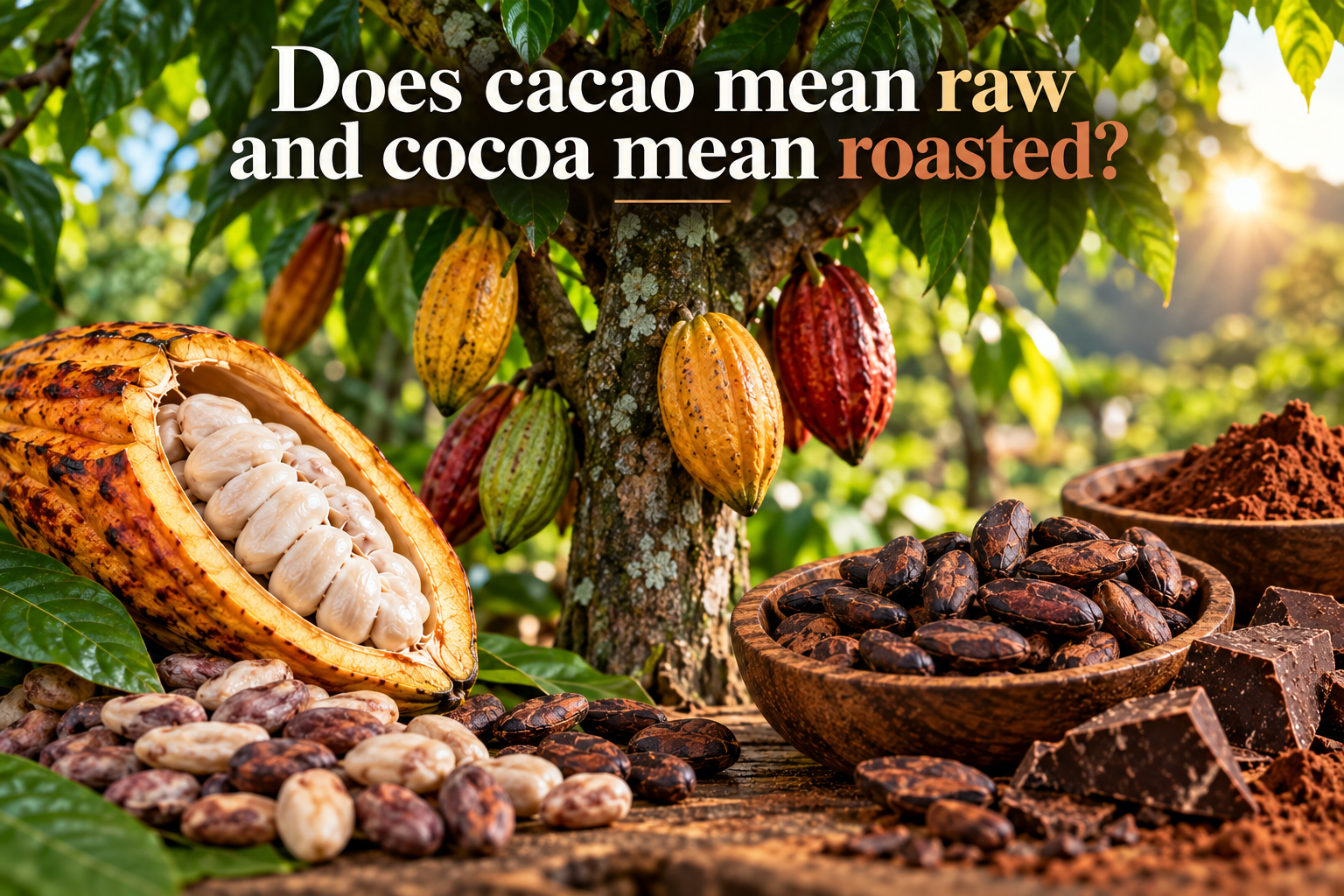 Does cacao mean raw and cocoa mean roasted?
You will often see this explanation:
Cacao = raw or minimally processed. Cocoa = roasted and processed.
It is neat, memorable and unfortunately, it isn't a reliable rule.
Across chocolate making, cocoa growing, scientific research and food manufacturing, both words are used in overlapping ways.
You can find:
cacao beans, cocoa beans
cacao nibs, cocoa nibs
cacao powder, cocoa powder
cacao butter, cocoa butter
The International Cocoa Organization itself uses the word cocoa when describing the crop from harvesting and fermentation through drying, roasting, winnowing and grinding.
So a product being labelled “cacao” doesn't automatically mean it is raw, minimally processed or nutritionally superior.
If processing matters to you, find out how it was actually made.
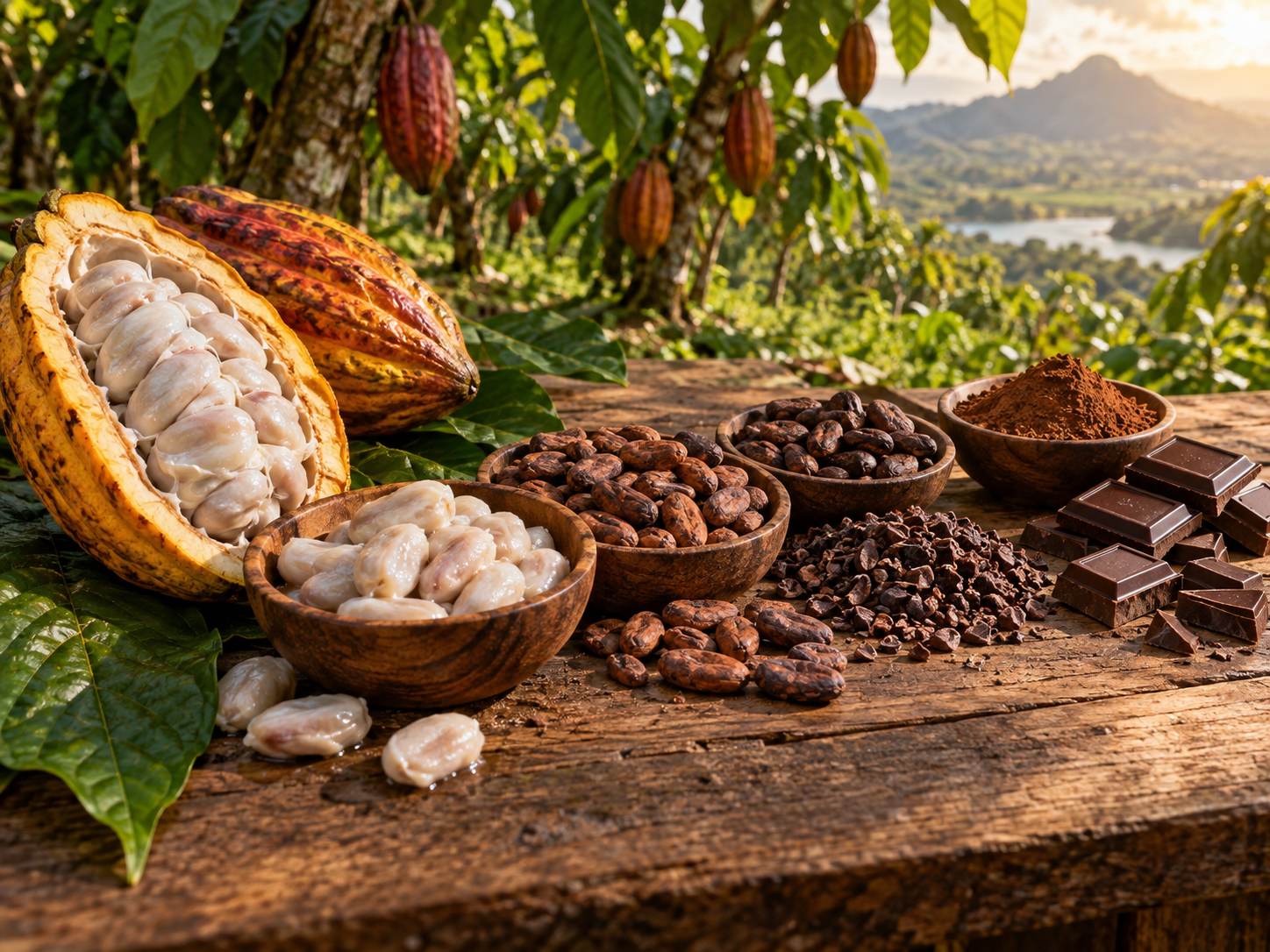
To understand the terminology, it helps to understand what happens to the fruit.
 1. Harvesting
Ripe cacao pods are harvested from the tree and opened. Inside are the seeds surrounded by white mucilage a wonderfully fruity pulp that can taste surprisingly tropical and refreshing. Chocolate at this point tastes nothing like the chocolate bar you know.
 2. Fermentation
The wet beans and pulp are fermented, traditionally in heaps covered with leaves or in fermentation boxes, this is one of the most important stages in creating chocolate flavour.
The pulp provides sugars for the microorganisms involved in fermentation, while a series of chemical changes begins inside the bean.
Chocolate flavour doesn't simply appear when a bean is roasted in a factory. Its foundations are being built at origin.
 3. Drying
After fermentation, the beans are dried. Reducing their moisture makes them suitable for storage and transport while continuing the development of flavour.
 4. Roasting
Chocolate makers then roast the beans according to the flavour profile they want to create.
There isn't one perfect roast for every cacao. Origin, variety, fermentation and the chocolate maker's desired flavour all matter.
 5. Cracking and winnowing
The roasted beans are cracked and the outer shell separated from the inside of the bean.
What remains are the cocoa or cacao nibs. Again, both descriptions are used.
 6. Grinding
Those nibs contain a considerable amount of natural cocoa butter. Grinding them releases that fat and eventually produces a flowing paste generally known as cocoa mass or chocolate liquor.
And despite the name, chocolate liquor doesn't contain alcohol. From here we can create chocolate, or the cocoa mass can be pressed to separate much of its cocoa butter from the cocoa solids.
Which brings us to another source of confusion.
What is the difference between cacao powder and cocoa powder?
The name isn't enough to tell you.
A manufacturer may call its product cacao powder, particularly when marketing it as natural, minimally processed or aimed at the health-food market.
Another manufacturer may call a similar product cocoa powder.
What matters is what has happened to it.
For example, cocoa powder can be natural or alkalised, sometimes called Dutch processed. Alkalisation changes characteristics including colour and flavour.
So instead of assuming that a packet saying “cacao powder” must be better than one saying “cocoa powder”, read the description and ingredients.
Ask:
Has it been roasted, alkalised?
Where was the cacao grown? Who produced it? How was it fermented?
Those questions tell me far more than whether somebody chose to put an extra “a” on the packet.
Cacao nibs vs cocoa nibs
This is another complicated question with a rather simple answer.
Usually, the spelling tells you nothing helpful.
Both terms describe pieces of the cacao bean after the shell has been removed.
A producer calling them “cacao nibs” may have processed them differently from a producer selling “cocoa nibs” — but you cannot establish that from the name alone.
If you particularly want unroasted nibs, look specifically for information saying that they are unroasted rather than relying on the word cacao.
Is cacao healthier than cocoa?
Be wary of anyone answering this question simply from the spelling.
How cacao has been grown, fermented, dried, roasted and processed can affect the finished product.
But “cacao” is not a nutritional guarantee.
Nor does the word “cocoa” automatically mean an inferior industrial product.
A beautifully fermented, carefully roasted fine-flavour cocoa bean doesn't suddenly become poorer quality because its maker calls it cocoa rather than cacao.
Equally, putting the word cacao on attractive packaging cannot transform mediocre beans into exceptional chocolate.
The important information is behind the name.
Why do I use both words?
Personally, I often use cacao when talking about the tree, fruit and experience at origin.
Cacao tree. Cacao pod. Cacao pulp. Cacao farm.
Once we move into international trade and chocolate manufacture, you will encounter cocoa everywhere:
Cocoa beans. Cocoa mass. Cocoa butter. Cocoa powder. Cocoa solids.
But I don't pretend there is an invisible line where cacao suddenly becomes cocoa.
Language is rarely that accommodating.
The part of cacao most people never taste
Perhaps the more interesting question isn't whether we call it cacao or cocoa.
It is why most consumers know so little about the fruit in the first place.
Chocolate uses the seeds, but the cacao pod contains much more.
Fresh cacao pulp is sweet and aromatic. It can be used to create juice and other drinks, and cacao by-products have potential uses ranging from vinegar to ingredients, flavourings and other value-added products.
This matters enormously.
For generations, much of the conversation around cacao has concentrated on getting beans out of producing countries and turning them into chocolate somewhere else.
I believe we should also be talking about creating greater value at origin and making better use of the whole fruit.
The future of chocolate isn't simply about making another bar.
Sometimes it begins by looking again at what we have been throwing away.
So, cacao or cocoa: which word should you use?
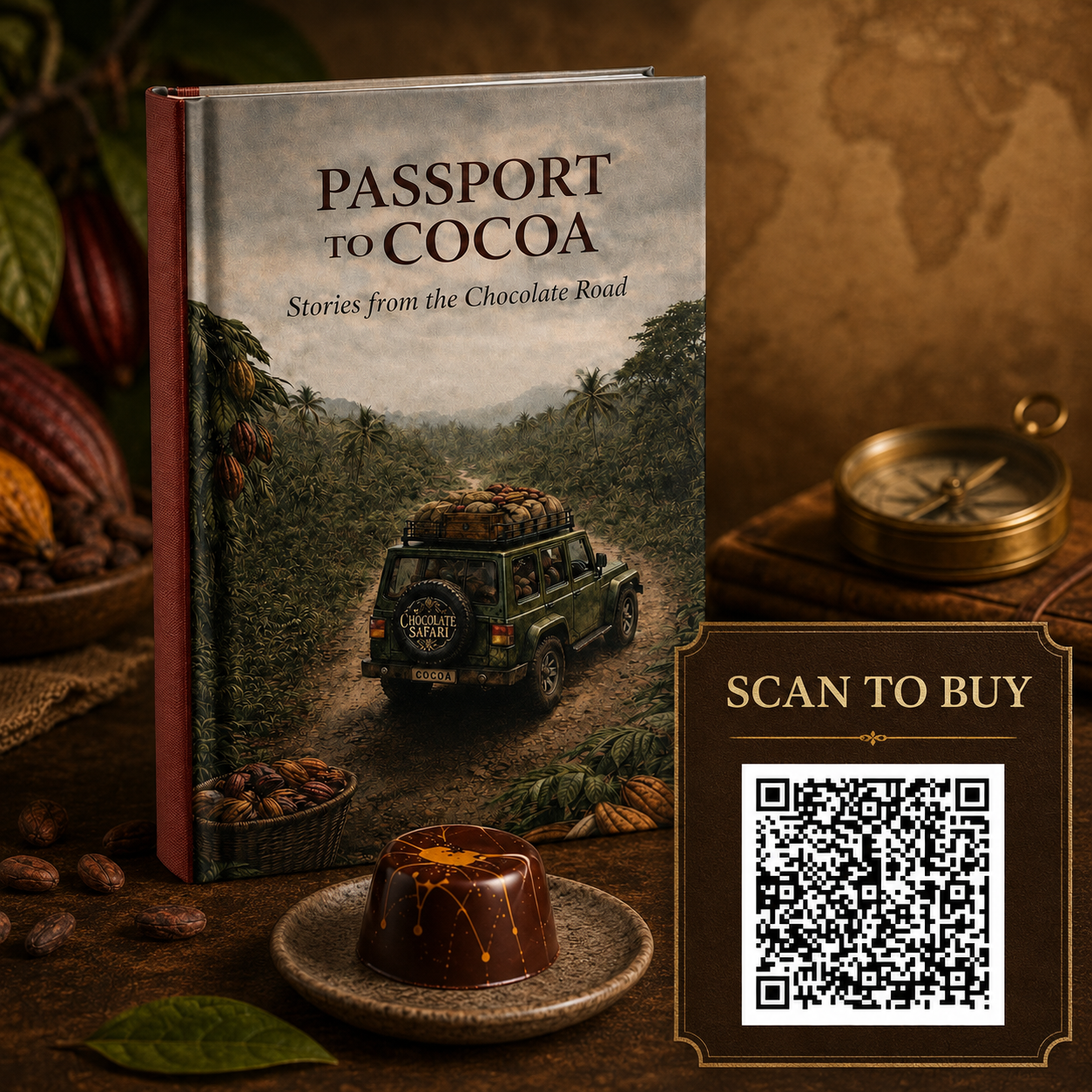 In my book passport to cacao it chose to exclusivly use cacao to avoid confusion
Use whichever term accurately communicates what you are talking about.
But don't judge quality by the spelling.
When buying chocolate or cacao products, concentrate on:
Origin.
Ingredients.
Fermentation.
Processing.
Roasting.
Traceability.
Flavour.
Those things actually tell you something.
The difference between exceptional and disappointing chocolate isn't an extra letter.
It starts on the farm, continues through fermentation and drying, and depends on every decision made between the cacao tree and the finished chocolate.
And that, ultimately, is far more interesting than arguing about whether we should call it cacao or cocoa.
Cacao vs Cocoa: Frequently Asked Questions
Are cacao and cocoa the same thing?
They both originate from Theobroma cacao, and the terms are frequently used interchangeably. There is no universal rule requiring cacao to describe unprocessed products and cocoa to describe processed ones.
Is cacao raw and cocoa roasted?
Not necessarily. Some brands use the words that way, but it is not a reliable industry-wide definition. Check the manufacturer's processing information if you specifically want an unroasted product.
Is cacao powder better than cocoa powder?
Not simply because it is called cacao. Look at how the powder was processed, whether it was alkalised, its origin and what you intend to use it for.
Are cacao nibs and cocoa nibs different?
The terms are commonly used for the same basic product: pieces of the cacao bean after the shell has been removed. Processing can differ between manufacturers, so check the product description.
What is cocoa mass?
Cocoa mass, also called chocolate liquor, is produced by grinding cocoa nibs until their natural cocoa butter is released and the mixture becomes a paste. Despite the word “liquor”, it does not normally contain alcohol.
What is Theobroma cacao?
Theobroma cacao is the scientific name of the tree whose seeds are used to make chocolate. The genus name Theobromais generally translated from Greek as “food of the gods”.