
Six products are arranged across the judging table.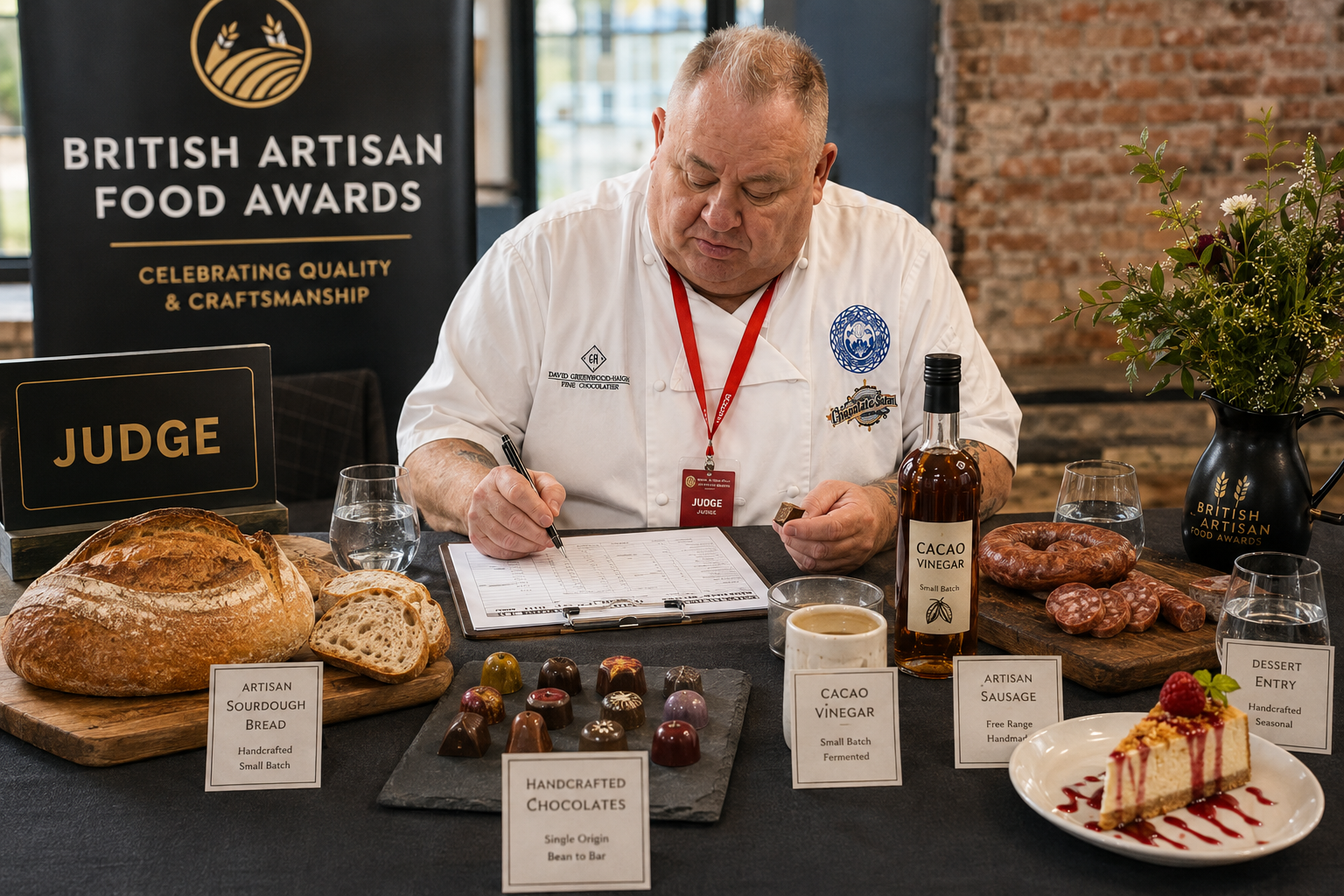
A cheese and jalapeño sourdough bloomer.
A wild venison sausage.
A bottle of mead vinegar.
A peach shaped mousse dessert.
A tub of
scone and jam ice cream.
hand-painted blackcurrant and cassis chocolate.
They could hardly be more different.
One has taken two days to ferment. Another begins with honey harvested from the producer’s own beehives.
One is made from locally managed wild venison. Another has been polished, painted, filled and finished over several painstaking days.
Each producer has a story.
Each product has a promise.
But once judging begins, every entry must answer the same fundamental question:
Does the product deliver what it promises?
That is where food judging begins.
Not with the label.
Not with the marketing language.
Not with the awards the producer has won before.
It begins with what is placed in front of the judges.
A good story cannot rescue a poor product
I love the stories behind artisan food.
I have spent much of my career working with chefs, chocolatiers, farmers, food producers and hospitality students. I understand the courage it takes to turn an idea into something another person can taste, assess and criticise.
Behind every entry may be a cottage kitchen, a family recipe, a new business, a farm diversification project or years of professional training.
That deserves respect.
However, a food award must ultimately recognise the quality of the product.
A moving story may help judges understand why an ingredient was chosen. Local sourcing may add value. Responsible production may strengthen an entry.
But none of these can compensate for bread that is underbaked, ice cream that is icy, chocolate that is poorly tempered or sausage that is dry.
The story should support the product.
The product must not depend upon the story to survive.
Does it taste like what it says on the label?
This sounds obvious, but it is one of the most common weaknesses in competition entries.
A cheese and jalapeño loaf should taste unmistakably of cheese and jalapeño.
A blackcurrant and cassis chocolate should allow us to recognise the dark fruit, the liqueur and the chocolate.
A scone and jam ice cream should offer more than a sweet dairy base with a few unidentified pieces suspended in it.
Judges look for clarity.
Can we identify the promised ingredients?
Do they complement one another?
Is one flavour overwhelming everything else?
Does the product taste natural, or has it become artificial, muddy or confused?
A long list of interesting ingredients does not automatically produce an interesting flavour.
The best products often have a clear idea and execute it exceptionally well.
Appearance creates the first expectation
We begin judging before the first bite.
The appearance of a product tells us something about the care behind it.
A sourdough loaf may be deliberately rustic, but rustic is not the same as careless.
An artisan chocolate may be individually decorated, but the finish should still show control.
A mousse shaped like a piece of fruit should immediately suggest the fruit that inspired it.
Judges may consider:
Shape and proportion
Colour
Consistency
Finish
Visible inclusions
Signs of damage or poor storage
Whether the appearance matches the product description
Absolute uniformity is not always desirable in artisan food. Handmade products should retain character.
But variation must look intentional rather than accidental.
Aroma is the first real taste
Before food reaches the mouth, aroma has already started shaping our response.
Fresh bread should offer fermentation, grain and baked crust.
Chocolate may reveal fruit, spice, caramel, nuts, flowers or roasted cacao.
A sausage should smell savoury and appetising without stale fat or excessive seasoning.
A vinegar should have enough aromatic complexity to invite tasting rather than simply attacking the nose with acidity.
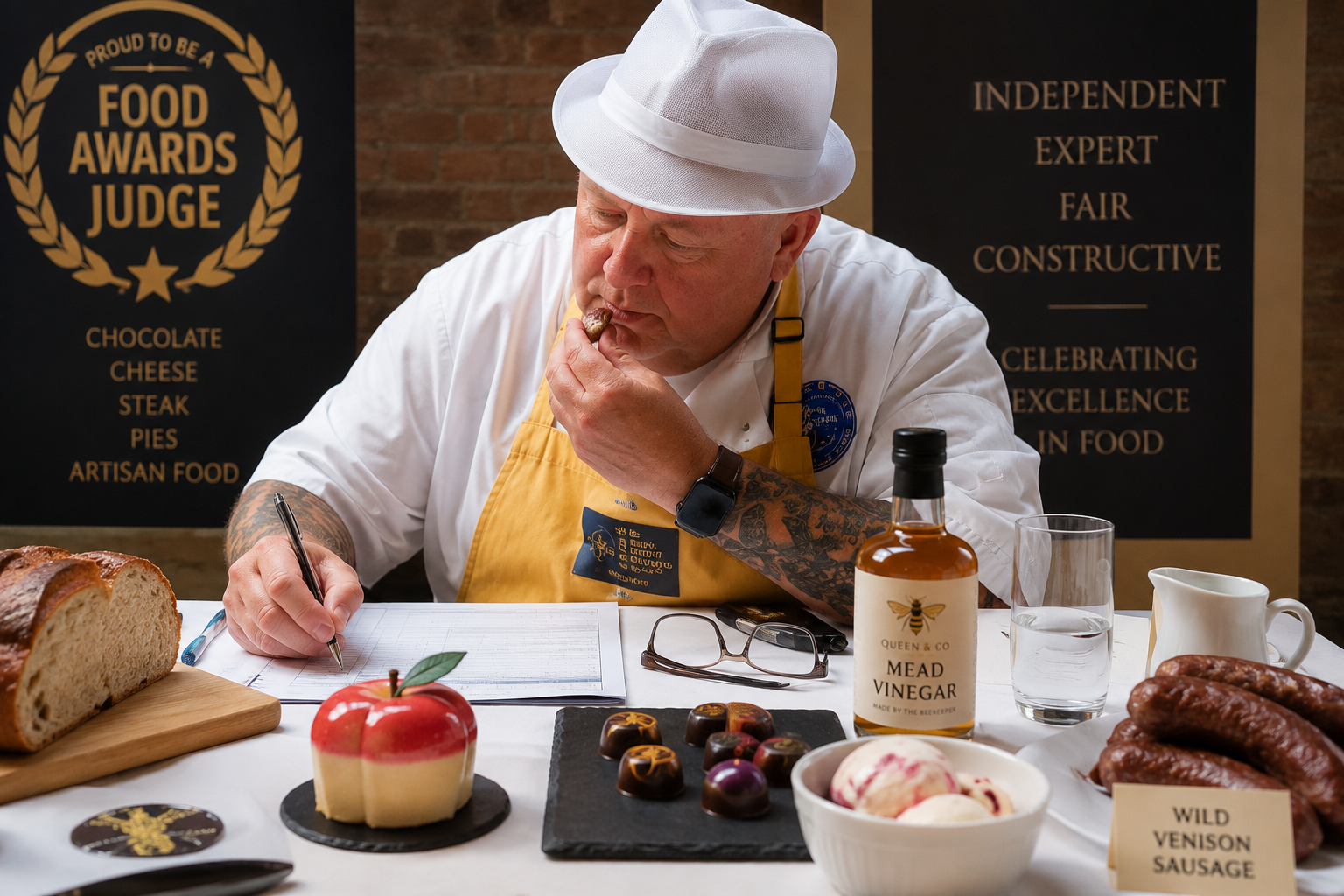 Judges pay attention to whether the aroma is:
Fresh
Clean
Appropriate
Distinctive
Balanced
Free from taints or faults
A beautiful product with very little aroma may feel disappointing. An aggressive aroma may suggest imbalance before the product is tasted.
Texture often separates good from award-winning
Flavour attracts attention, but texture frequently determines whether a product earns an award.
Consider the range of textures a judge may encounter in a single session.
The crust and crumb of bread.
The bind, casing and succulence of a sausage.
The smoothness of ice cream.
The shell thickness and filling of a chocolate.
The structure of a mousse.
The viscosity and finish of a vinegar.
For each product, we ask whether the texture is appropriate and pleasurable.
Is the sourdough crumb gummy or properly baked?
Has the bread retained enough moisture?
Is the sausage juicy or dry?
Does the ice cream melt cleanly, or does it contain large ice crystals?
Has a frozen piece of scone become hard and unpleasant?
Does the chocolate shell break cleanly, or is it thick and difficult to bite?
Does the mousse hold its shape while remaining light?
Technical faults often reveal themselves through texture before they become obvious in flavour.
Balance matters more than intensity
Producers sometimes believe that making a flavour stronger will make a product more impressive.
More chilli.
More salt.
More smoke.
More acidity.
More sugar.
More alcohol.
But strength is not the same as balance.
A jalapeño loaf should have warmth, but the chilli should not erase the cheese or the flavour of the fermented dough.
Cassis should add character to a chocolate filling without making it harsh or medicinal.
A mead vinegar should have sufficient acidity to function as vinegar while retaining something of the honey and fermented mead from which it was made.
Judges are not simply looking for impact.
We are looking for harmony, each element should make sense in relation to the others.
The finish matters
Good judging does not stop when the food has been swallowed.
What remains?
Is the finish clean and pleasant?
Does the flavour develop?
Does it disappear too quickly?
Is there an unwanted bitterness, greasiness, artificial sweetness or burning heat?
Would you willingly take another bite?
That final question is important.
A competition sample may be small, but an award-winning food must work as a complete product. Something that is exciting for one mouthful but exhausting by the third may not succeed with customers.
Local provenance must be specific
“Made with local ingredients” is a powerful claim.
It is also a claim that should be supported.
Judges want to know:
Which ingredients are local?
Who supplied them?
Where were they grown or produced?
How far did they travel?
Are they genuinely local or simply bought from a local shop?
Are the ingredients used in the entered product, or elsewhere in the producer’s range?
There is a difference between buying imported butter from a nearby retailer and using butter made by a local dairy.
Both may be perfectly acceptable, but they are not the same claim.
Specificity builds trust.
“Blackcurrants grown on an allotment in Wollaston” is stronger than “fruit sourced locally where possible.”
“Venison harvested within approximately ten miles of our production premises” gives the judge something meaningful to assess.
A named farm, grower, beekeeper, mill, dairy or supplier makes provenance real.
Value for money does not mean cheap
Judges should not reward the lowest price.
We assess whether the product offers fair value for the experience it delivers.
That may include:
Product weight or portion size
Ingredient quality
Production time
Technical skill
Packaging
Shelf life
Local sourcing
Originality
The likely customer experience
A handmade product may reasonably cost more than its mass-produced equivalent.
A loaf fermented over two days cannot be judged solely against a supermarket sliced loaf.
A hand-painted filled chocolate cannot be compared only by weight with an industrial chocolate bar.
However, premium pricing creates premium expectations.
If a product costs more, the quality, presentation, flavour and consistency must justify that price.
Allergen management is part of quality
Allergen information is not an administrative afterthought.
It is part of producing food professionally.
A product containing cheese should identify MILK.
Bread should identify cereals containing GLUTEN, with the specific cereal declared where required.
Products containing nuts, eggs, sulphites or other regulated allergens must communicate them accurately.
Judges may look for:
A complete ingredient list
Allergens clearly emphasised
Evidence of allergen training
Cross-contamination procedures
Batch and recipe records
Consistent information across labels, websites and market signage
A delicious product with incomplete or inaccurate allergen information is not a professionally finished product.
Safety, trust and quality belong together.
Sustainability needs evidence, not slogans
Most producers now understand that sustainability matters.
The strongest entries explain what they are actually doing.
There is an important difference between:
“We would like to introduce recyclable packaging.”
and:
“Our tubs are recyclable, our spoons are wooden and we use an electric vehicle for local deliveries.”
One is an ambition.
The other is evidence.
Judges may consider responsible sourcing, packaging, energy use, water use, waste, transport, biodiversity and contribution to the local community.
Small businesses should not feel they need a complex corporate sustainability report.
Honest, specific examples are more valuable than broad claims.
Using surplus ingredients in another recipe, composting suitable food waste, producing to order, harvesting from an allotment or consolidating deliveries are all valid actions.
Say what you do.
Explain how it works.
Where possible, show the result.
Consistency is essential
A judge may taste one loaf, one sausage, one chocolate or one spoonful of ice cream.
A customer expects the next purchase to be just as good.
That is why consistency matters.
Are inclusions evenly distributed?
Are portions controlled?
Are recipes recorded?
Are production temperatures monitored?
Does every chocolate have a similar shell thickness?
Will the chilli level be the same in the next batch?
Artisan production does not have to mean unpredictable production.
The maker’s hand should bring character, not uncertainty.
Good judges do more than find faults
Professional food judging should never be an exercise in showing how clever the judge is.
The purpose is to recognise excellence, protect the integrity of the award and give useful feedback.
A comment such as “I did not like it” tells the producer very little.
A constructive judge explains why.
Perhaps the acidity dominated the fruit.
Perhaps the bread needed longer baking.
Perhaps the frozen inclusion became too hard.
Perhaps the chocolate shell was too thick for the delicacy of the filling.
Perhaps the provenance story was compelling but unsupported by enough detail.
Useful feedback should help the producer understand what worked, what did not and what could elevate the product.
Behind every entry is someone who chose to place their work in front of strangers and ask for an honest opinion.
That deserves rigour.
It also deserves respect.
What turns a good product into an award winner?
Award-winning artisan food usually succeeds across several areas at once.
It delivers its stated flavour.
It is technically well made.
Its texture is appropriate.
Its appearance creates confidence.
Its ingredients make sense.
Its story is truthful.
Its provenance is clear.
Its price is justified.
Its labelling is professional.
And, most importantly, it makes the judges want to taste it again.
An award sticker may help a product attract attention.
But the real test comes later.
Would a customer buy it again when there is no judge, no producer standing beside the table and no story being explained?
If the answer is yes, the product may have something special.
Looking for an experienced food competition judge?
I am David Greenwood-Haigh, an award-winning chef, chocolatier, international food consultant and professional food judge.
My judging experience spans chocolate and confectionery, artisan foods, steak, pies, cheese and broader culinary competitions. I bring decades of practical food-industry experience, sensory evaluation skills and an understanding of both artisan production and commercial product development.
I am available for:
UK and international food awards
Chocolate and confectionery competitions
Artisan food and drink judging
Chef and student competitions
Product innovation panels
Blind tasting and sensory evaluation
Pre-award product assessment
Head judge and judging-panel roles
Competition hosting, demonstrations and awards presentations
My approach is independent, constructive and respectful of the people behind the products.
I judge what is in front of me.
I explain my decisions clearly.
And I never forget how much work may be contained in a single mouthful.
To discuss appointing me as a judge, head judge, panel chair or sensory evaluator, contact Coeur de Xocolat with the event name, location, dates, product categories and expected judging format.